Tuesday, March 21, 2006

Hello Robosapien

Wu Zheying u0303820 Robosapien is a toy robot that can be programmed to move, speak, lift objects and function in unique ways with certain modifications. Introduced to the world in year 2005 by Mark W Tilden, a robotic scientist who has worked with NASA before, it has since spawned several different versions – versions 1, 2, 3 of which version 1 has garnered the U.S toy industry’s TOTY (Toy Of The Year) Award. Versions 2 and 3 are not due for release, yet there are already several websites dedicated to the modification and hacking of the robot for different purposes. I will be talking about Robosapien version 1 from here on, as versions 2 and 3 are not out on the market yet.

Technology

Robosapien can be classified as belonging to a product of the area of biomorphics, an area that is a sub-field of robotics. Biomorphics is a robotic technology that centers around building robots around the theory of emulating the bio-mechanisms, sensors, structures of animals. In short, it is building robots inspired by the principles of biological systems. Though seemingly easy to achieve by animals and humans, movement and sensing is considered a considerable challenge in robotics and remains a field that is still at its infancy in research.
Features

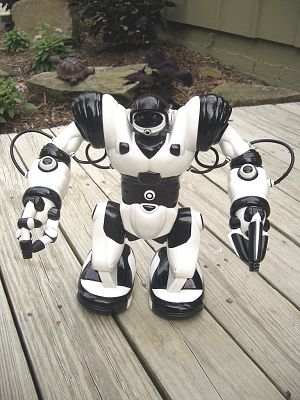
Robosapien stands at 14 inches tall, and weighs 4.5 pounds with batteries. It uses 4 D size batteries for the main robot and 3 AAA size batteries for the remote control. The remote control uses infra-red technology to communicate and program the robot. Using infra-red technology means that the robot can be controlled not just by the manufacturer’s remote control, but by any device that has infra-red connectivity and a suitable software system. Most PCs and palm tops would be able to achieve that.

Robosapien is capable of walking unaided without the wheels on his feet. He can grasp and throw objects, speak with pre-recorded ‘caveman’ like voices and other sound effects.

It is able to be programmed with the remote control and can execute a total of 67 different commands.

Technical Specifications
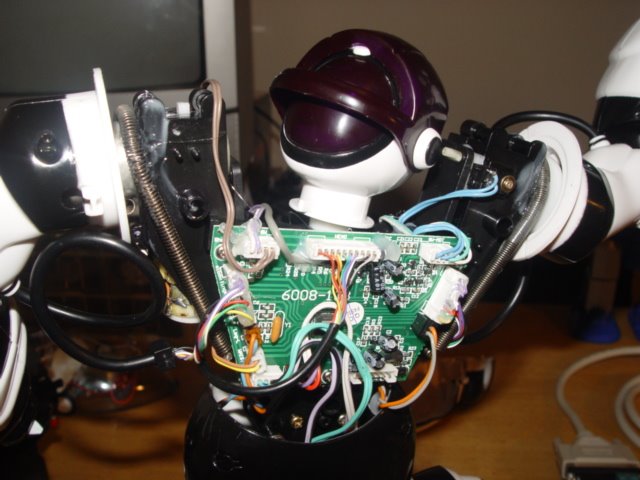
The ingenuity of the Robosapien is that it does not even have an in-built microcontroller. Instead, it uses a combination of simple controllers to control the different parts of the robot function. A PCB is inbuilt into the center of the robot’s torso. The PCB houses 2 controllers, one for main functions like LED, shoulder, finger movement, the other for motor functions like upper torso, shoulder, hand, leg movements. It also has additional sonic and infra-red sensors together with accompanying clock generators and sound amplifiers. The simplicity of the PCB board with solder points allow hackers and hobbyist to modify the PCB board by changing resistor, capacitor values and attaching additional microcontrollers, DSPs, speech generators and other more novel devices to the robot. In addition, the entire robot casing can be detached and users can modify parts to their delight. This ups the value of the robot tremendously as users wont be bored with it after a few plays, there seems to be more things the robot can do!

The different functions of the are combined and programmed by using the remote control or with a downloadable software from the manufacturer, WowWee. For this purpose, the remote control is complicated with 27 different buttons.

The Robosapien is equipped with a basic level of programmability. You can string together commands to form your own macros or mini-programs. These programs can be played back as the result of pressing the "execute" button, as the result of touching one of the sensors on his hands or feet, or by putting him in "listen" mode and making a sharp noise. For example, you could program him to Burp, Fart, and then give someone the High Five any time someone touched his left hand.

Design

The robot’s design is based on sleek and smooth lines with contrasting colours of black and white, neutral colours that never die out with passing fads. The robot look feels like its being inspired by robot structures drawn by Japanese Manga (comic) artists. All in all, the robot looks really cool and stylish. Not forgetting the remote control, both complement each other in the looks department and definitely wets people’s appetite for a buying frenzy!

Uses/ Modifications
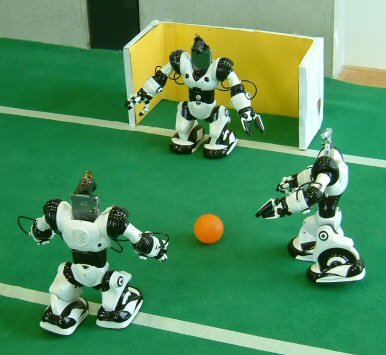
Since its introduction to the market, Robosapien has spun off many different hobbyist versions like ‘balancing Robosapien’, ‘dancing Robosapien’ and some serious dudes at the University of Freiburg have even modified their own robots to be able to play in the RoboCup, a prestigious Humaniod League of soccer style game. For this though, the robot was heavily modified, with its 'head' removed and refitted with image sensors, its torso dissected and rewired with a more powerful microcontroller. In this sense, the Robosapien has evolved to be a autonomous one as compared to its previously semi-autonomous status.

Future The future of Robosapien looks good certainly. With version 2 already hitting the shelves as we speak and version 3 in the pipelines. Version 2 promises to be a robot with more 'soul', with upgraded behaviours and autonomous status. It also promises to be more bulky and expensive due to the added microcontroller circuit board and additional motors. With its infra-red communications mode hacked to that of a Radio Frequency one, the uses of this biomorphic metallic dude can be applied to the areas of military defence, survelliance, disaster-rescue situations, and as rehabilitative devices for disabled children and pets. Say hello to the world, say hello to Robosapien.

Robot Soccer Game: http://www.nimbro.net/rs/

References: Review of the Robosapien by Gadget News: http://www.the-gadgeteer.com/review/robosapien_robot_review Hacking a Robosapien: http://personal.strath.ac.uk/mark.craig/robot/hackrobos.shtml

Monday, March 20, 2006

Mars Rovers, Spirit and Opportunity

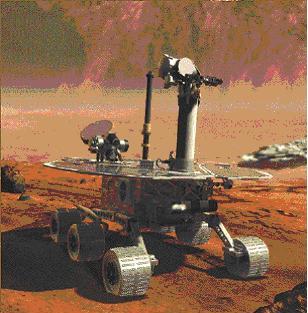
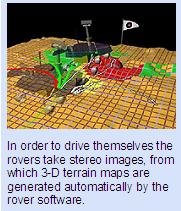
S0500130 Andreas Lars Johan Roupe Since many years ago humans have been very interested in space and to explore and get out in the space. For the last decades we have been very interested in other planets i.e. the “red planet” Mars. Right now there are i.e. robot rovers on Mars, Spirit and Opportunity ( Mars Exploration Rovers). They were launched in June and July 2003 and they landed on Mars in January 2004. In the beginning it was supposed to be there three month and then stop, but is has take over two years now and they are still searching for signs of life on Mars. Why is Mars so interesting? Mars is the planet which is most Earth-like planet. It may once have had/still have liquid water and thus life and it may be possible to colonize. NASA’s Mars Exploration Strategy is to “Follow the water”, “Water is key because almost everywhere we find water on earth, we find life.” The challenges for these robot rovers are (1) that the communication time delay is around 20 min which means that if you change something on a computer on earth, it will take 20 minutes before the robot gets the information, (2) there are in extreme temperature, (3) rough and rocky terrain, (4) dust and (5) no global positioning system (GPS). How do these robot rovers work and how are they controlled?? Having more physical capability than 1997's Sojourner rover, Spirit and Opportunity also needed more autonomy. Engineers improved the auto-navigational driving software to give the golf cart-sized explorers more freedom. To navigating themselves, the rovers get a command telling them where to end up, and then evaluate the terrain with stereo imaging to choose the best way to get there. They must avoid any obstacles they identify. This capability result in longer daily drives than would be possible by simple depending on step-by-step navigation commands from earth. The auto-navigation system takes pictures of the nearby terrain using one of the Mars Exploration Rover stereo camera pairs. After stereo images are taken, 3-D terrain maps are generated automatically by the rover software. The way is determined from the height and density of rocks or steps, excessive tilts and roughness of the terrain. Dozens of possible paths are considered before the rover chooses the shortest, safest path toward the programmed geographical goal. The rover then drives between 0.5 and 2 meters closer to its goal, depending on how many obstacles are nearby. The whole process repeats until it either reaches its goal, or is commanded to stop. The average obstacle-avoidance driving speed for Spirit and Opportunity is nearly 34 meters per hour [1]. To get power to do this movement they use solar cells. Another improvement in software that has been made is Visual Odometry [2]. When the rover drives over sandy and rocky terrain, they can make slips. But the Visual Odometry gives the rovers a much better notion of how far it has actually travelled. It works by comparing pictures taken before and after a short drive. NASA is working to give rovers more autonomy so that missions can conduct more science with fewer people. Meanwhile, opinions vary about the degree of autonomy that is needed for future missions, or if any is even appropriate onboard planetary rovers and spacecraft. Most agree, though, that higher intelligence is imperative, for deeper space exploration and for more productive planetary missions. [3] So the question is, how far can we go???

Sunday, March 19, 2006

NASA Space Robotic Probes

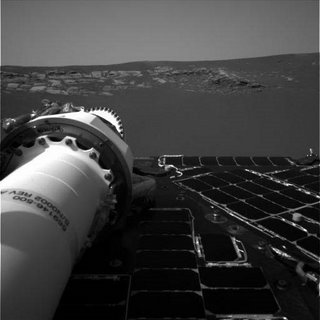
U0204999 Sim Xin’An Eddie Has anyone of you guys seen the latest Heineken Beer Ad on a space exploration probe? Well for those who have unfortunately been unable to catch it, you can view it here, http://www.visit4info.com/details.cfm?adid=23072 It’s a hilarious beer ad on the robotic space probes that have since 1996 began exploring the Planet Mars for signs of life and to investigate the possibility of human inhabitation there. However jokes aside, if you view the ad properly, the ad was based on the Sojourner, Spirit and Opportunity robotic space probes that have already landed on Mars. The technology used for the probes to land and subsequently explore the land was also a realistic view of what Sojourner, Spirit and Opportunity did once they were in space which leads me to my topic on Robotic Exploration in space. NASA has always placed a great emphasis on its explorations in space and beyond, having come a long way since the days of Neil Armstrong and his historic landing on the moon. Lately, their attention span and mission objectives have been on the inhabitable regions of Planet Mars. In 1997, the Mars Sojourner robot traveled for a period of 83 days before stopping as its power ran out and is now staying there till it gets recovered one day. Then in June 10 and July 17 of 2003, Spirit and Opportunity were both respectively launched to search for the history of water in Mars. Both landed in January and began its exploration in the Gusev crater and the Meridiani Planum where minerals have suggested that Mars had a wet past that supported life there some billions of years ago.

Picture showing the Red Planet, Mars just before the sun shines on it

Since their arrival, they have embarked on an originally planned 90 day mission but have since far exceeded that time span and is still operating as we speak. Sending back rich information including pictures, mineral and data reports, these robots are an absolute marvel as they operate in the harsh red landscape of Mars. We shall now take a look at the technology that Sojourner, Spirit and Opportunity are using during their amazing space adventure.

Power The power used by the robot probes is solar power. This is true for all three probes and consists of solar arrays on panels that look like the robotic probes have wings. However this is absolutely necessary to increase the so called area of energy absorption that the vehicle could collect. With this new innovation, the robots could travel further and faster especially during the day where the sun is supplying the natural energy. Another innovation is the use of Triple Junction Gallium Arsenides which are three layered solar cells. This is a first for NASA in sending up solar cells made of these junctions but it gave both Spirit and Opportunity an added advantage over Sojourner which had only single junction solar cells. The added advantage is of course a greater ability of both Spirit and Opportunity to absorb greater power and this is accentuated in the fact that Sojourner only traveled 83 days and lost power after that.
Picture showing how the solar arrays are layed out on the vehicle Yet another improvement over Sojourner was that Spirit and Opportunity both carried two 8-amp hour lithium batteries as opposed to Sojourner’s 40-amp hour lithium battery. Apparently both Spirit and Opportunity had a supply of 900 watt hours of energy per day, more than Sojourner. However the major drawback in solar energy is that Sojourner could only operate in regions of intense and high solar regions which meant only the equatorial regions could be explored in Mars. NASA is thinking of alternating between different power sources which could give future robotic probes a way to explore the whole of Mars. The challenge is of course to find different power sources that are small enough, mobile enough and can supply enough energy to these probes.
Telecommunications Both robotic probes Spirit and Opportunity both talk to earth via two orbiters that are circling Mars, namely Mars Odyssey and Mars Global Surveyor. As the orbiters circle Mars, everyday there is a tight time span of 10 minutes for the two robotic space probes to communicate information via UHF antennas and the amount of information transmitted is roughly 76 megabits for Odyssey and 8 megabits for Global Surveyor. The two orbiters use X-band communications to transfer information back to Earth at a faster rate than that of the two robotic probes transferring information to the orbiters. I am of the opinion that if possible, the robotic space probes could be improved to rely on X-band communications as well to facilitate the information transfer. With a window period of information transfer set at only 10 minutes, this faster communication method could possibly give the two robotic probes a better success rate at transferring information back to earth.

The first images of Mars from the camera on Spirit being sent back to earth via the orbiters

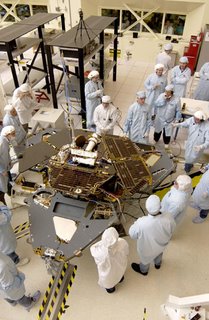
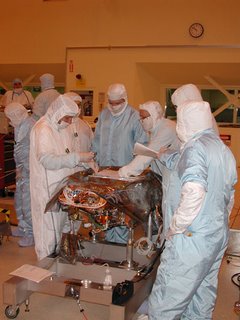
Also, as the Deep Space Network on earth that receives data from outer space has to cater to all space exploration projects, this faster and better efficiency could be transferred to less time span required for earth to receive information thus allowing the Deep Space Network antenna to cater to other projects as well. Avionics So what really drives the robots? The answer has got to be its brain or processor which can easily rival that of a high end laptop. An improvement over Sojourner is that Spirit and Odyssey have a memory space of over 1000 times more and have 256 megabytes of flash memory that allows it to retain information even when there is no power. The processor is stored in a Warm Electronics Box which in turn is protected by the Rover Electronic Module.

Picture showing how scientists work on the Warm Electronics Box, the brain of the robots
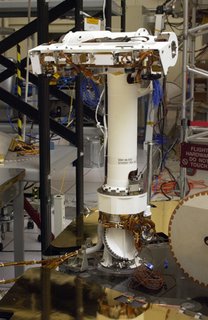
Some of the features include gold plated walls and insulation features which help keep the Box warm especially at night where Mars temperatures drop to -96 degrees Celsius. The other feature of the robot is that it has an Inertial Measurement Unit that measures the tilt on which the robot probe is on. This allows the robot to check its movements and realign its Centre of Gravity to prevent it from toppling over and giving it more overall stability. Another astounding feature of this high end robot is that it actually conducts its own functionality checks and hence maintains its feasibility in tough conditions where humans could not help service it. Software Engineering The robotic probes of Spirit and Odyssey have huge improvements in software engineering and we shall now examine some of these. One of these include its Autonomous Planetary Mobility which we will examine later. The robotic probes are programmed to actually self navigate and assess the dangers imminent as they move along the surface of Mars. Both Spirit and Odyssey also have 24 cameras of the highest resolution and lightest weight and can send back awesome pictures of Mars.

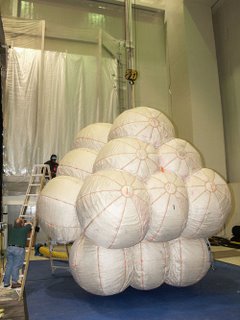
Picture showing the "head" and the "neck" of the robot fitted with cameras to take panoramic views Image returns is also enabled in this system known as the ICER wavelet based image compressor that compresses the images to enable more to be sent back at one go. Range and Reachability maps also allow scientists to gauge exactly where the probe has to go and helps form the landscape of Mars. Entry Features Two features which are interesting in helping the probes land are the airbags and rockets. The airbags help reduce the damage of the landing impact and coupled with a parachute, completely aids the landing of the probes on Mars without any damage whatsoever. Picture showing the airbags that will cushion the rover's impact with the surface of Mars upon landing

Also rockets were fired by three rocket-assisted descent (RAD) motors to help reduce the speed of the probes landing. When the craft is about 2.4 km from the surface, the Descent Image Motion Estimation Subsystem (DIMES) takes pictures of the surface and analyzes them to predict horizontal speed. This is important as strong winds at the Gusev crater could impede a safe landing objective. To counter the winds, the Traverse Impulse Rocket System (TIRS) also kicks in to stabilize the spacecraft. Autonomous Planetary Mobility The last technology feature is how this system allows the robotic probes to navigate and move around on Mars. It has firstly an Improved Mobility System that helps to counter the extreme centre of gravity problems that used to plague Sojourner. Its system is located at the back of the vehicle with wheels that are larger and has a special spiral flecture pattern that allows shocks to be absorbed by the spoke and the wheel rather than letting it reach the other parts of the rover. Also it has a unique rocker-bogie system that allows the robot to overcome obstacles bigger than its wheel diameter. For an example of how this works, you can see the Heineken advertisement link I put up above in the starting paragraph and notice how the robot maneuvers. Each wheel also has cleats that give the robot better grip over soft sand.

To navigate around Mars, both Spirit and Opportunity had more autonomy than Sojourner. They both have an auto navigational system whereby all scientists had to do was to key in the coordinates of where they want the robot probe to go and the robots will self assess the terrain and devise the best way possible to reach the destination. This system is quite revolutionary and you can view the movie clip of how it works here.

http://marsrover.nasa.gov/gallery/video/movies/mer_rovernav_240.mov

Opportunity has used this system to drive for 230 metres and Spirit 80 metres. What the auto navigational system does is to take many pictures of the surrounding and piece together a 3D landscape image of the terrain and from there the robotic probes assess the obstacles in its region with 16,000 possible points per step. Lastly, as each robot moves, it could perhaps fall short of its expected distance due to soft sand and possibly even slopes which cause the robots to slip backward. However one new feature is the Visual Odometry software system which compares images of surrounding features before and after its motion and determines whether the distance it has moved is the right distance. This is far better than the usual system of calculating the distance traveled by the wheels of the rovers as soft sand slipping could even occur when wheels are locked. Conclusion Both Spirit and Opportunity are still on Mars and even now face challenges as evidenced by latest news reports which talk about how one of Spirit’s wheels have stopped working completely and is now a burden to its other wheels as Spirit has to drag it along. The challenge update presently is that as solar powered robotic vehicles, Spirit has to reach a slope on Mars where it can catch enough sunshine to operate throughout the Martian winter which is descending upon Mars in approximately a hundred days which barely leaves Spirit with enough time to make it there with its faulty wheel causing excess friction. The success of these robotic space probes show that although robots are not astronauts and can’t possibly provide substitutes for them, they help to increase our capabilities into the unknown and efficiently make scientific breakthroughs while we are still within our safety zone. Stay tuned on the webpage links below if you are interested to see if Spirit actually makes it. 1. http://antwrp.gsfc.nasa.gov/apod/ap970707.html 2. http://www.bizjournals.com/washington/stories/1997/07/14/story3.html 3. http://mars.jpl.nasa.gov/

Saturday, March 18, 2006

Assistive & Healthcare Robotics - Because Elderlies Deserve More...

U0205260 - Domingue Jean Michel David (Apologies on the unoriginal innovative title and intro =P) Have you read this post by Janesh on the Human Washing Machine? If you haven’t done so yet, I suggest that you click here and take a look. Go now – we’ll be waiting for you ;-) Yes you read right – a washing machine for humans. Adjusting the temperature of the water and releasing body shampoo, the cleansing action kicks in for the person to enjoy a bubbling bath. The most useful application here is for elderlies and at the rate at which the population is aging, it is looking to be for everyone's benefit - clever, practical and attractive automated and robotics products to help us age gracefully. Which leads us nicely to the topic of robots at the service of elderlies. Assistive technology and healthcare robotics is fast becoming the future of elderly healthcare. As reported here, the Japanese are developing ultimate care givers for people. The application developed here is the robot suit "Hybrid Assistive Limbs (HAL)" and is aimed at helping elderly people with weak muscles or physical difficulties. "HAL is state of the art power assist system in the world" It looks like an armor, or "a motor-driven metal exoskeleton" and straps onto a person’s arms, legs and back. The system automatically adjusts itself to the wearer. How? When anyone wants to move, stand or walk, electric current on the skin's surface are generated when nerve signals are sent to the person's muscles. These currents are picked up by the sensors - a bio-cybernic system consisting of bioelectronic sensors (angle sensors, myoelectrical sensors, floor sensors) is used here. A computer (which, together with motordrivers, measurement system, wireless LAN, and power supply is carried as a backpack) receives these signals and translates them into signals of its own for controlling motors at the joints (hips and knees) of the exoskeleton. Coordination of further movements by the system is done using the known state of the suit and recorded patterns of the wearer. The control system itself consists is a hybrid one with an autonomous controller (posture control) together with the power assist controller based on the biosensors input and predictive feedforward. As shown in the picture, the student testing the suit can hold three packs of rice(!) but more importantly, the suit can give an average man twice as much strength - it allows "a person who can barely do an 176-pound leg press handle 397 pounds." Interestingly, “the motors respond faster to signals from the wearer's brain than their own muscles”. As patients with brain and spinal injuries request for more of this new application, the developers are looking to include medical rehabilitation with the suit. Click on the picture for a more detailed view. Read more about it here, here or here. The market for assitive robotics is still very young and results have shown that robot technology in this area have greatly help to boost recovery of patients.
At the same time, it seems that in the quest for advancements in robotics, assistive and healtcare robotics is a good platform for such development. Alongside Medical robotics, assistive ability and learning to care for and help humans is an area where much higher level of automation can be developed and tested for robots.

Friday, March 17, 2006

Robot nurse escorts and schmooze the elderly

U0205353 Chung Chan Lee A robot that does more than clean the carpet Robot nurse escorts and schmooze the elderly Manager of Intel's Proactive Health Research lab, Eric Dishman foresees that countries around the globe will soon face the problems associated with a cresting age wave. “Starting at the end of this decade, the first wave of baby boomers will retire and the population of eldery people will swell” he says. Together with Pollack, and researchers from four schools: the University of Michigan, Pittsburgh, Carnegie Mellon, and Stanford, the nursebot project has been started to test out a range of ideas for assisting elderly people, such as reminding elderly patients to visit the bathroom, take medicine, drink, or see the doctor; connecting patients with caregivers through the Internet; collecting data and monitoring the well-being of patients; manipulating objects around the home such as the refrigerator, washing machine, or microwave; taking over certain social functions with elderies

The robot Pearl is a typical prototype of the nursebot project. Pearl deals with old men and old women. Her job is mainly about reminding her clients to eat, drink, take medicine or use the bathroom, she also guides the old folks from room to room as she chats about the weather or TV listings. Pearl is a self-directed mobile robot with an advanced artificial intelligence to assist people with the activities of daily living. This summer, this 4-and-a-half-foot-tall robot nurse is underway her field testing at Longwood Retirement Community in Oakmont, Pa., and She has won the hearts of elderly folks there. “We’re getting along beautifully,” says one older gentleman as Pearl leads him to a room for his therapy session at Longwood. “But, I won’t say whether she’s my kind of girl,” he quips.

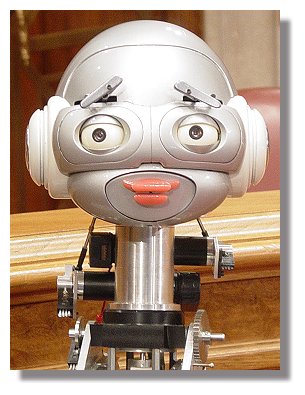
Pearl manage to perform some simple face expression, tough still a little bit funny. Pearl's designers say that they took special care to make Pearl prettier, but it's what's inside Pearl counts: Two Intel® Pentium® 4 processor-based PCs run software to endow her with wit and ability to navigate; a differential drive system propels her; Wi-Fi helps her communicate as she rolls along; laser range finders, stereo camera systems, and sonar sensors guide her around obstructions; microphones help her recognize words; speakers enable others to hear her synthesized speech; an actuated head unit swivels in lifelike animation. All this and more is housed in her slender frame.

Reference: http://www.intel.com/employee/retiree/circuit/robot.htm

Thursday, March 16, 2006

ROBONOVA-I: Ballet-dancing robot

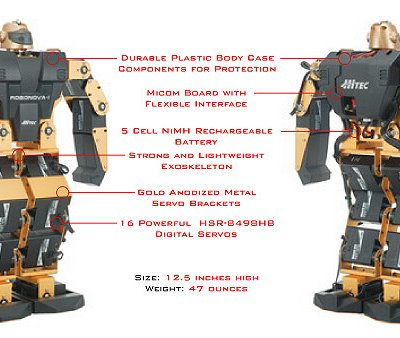
U0205233 Oh Ai Ni Irene Edutainment robots have been developed over the decades. However, developing an edutainment robot from stratch is a difficult task for the amateurs and students, due to lack of hardware and programming expertise. Hitec Robotics has released a full edutainment robot package named Robonova-I. It is a humanoid robot, which means its anatomy of the limbs and joints are designed to be as similar to the human body as possible. This means that it can perform many actions such as walking, running, doing flips, cartwheels and dance moves. This makes development of edutainment robots easy for students, researchers and hobbyists. Developing a customized robot also requires the user to have adequate knowledge in robot programming. In this full robot package Robonova-I, the user can create operational functions with mouse click without knowing any robot programming language, with the supplied RoboScript programming software. RoboBasic is a programming tool based on the BASIC programming language and is provided For the more advanced users, RoboBasic, which is based on the BASIC programming lanaguage is provided. In additional , there is a Catch & Play Function allows a simple way to program ROBONOVA-1. Using RoboScript or RoboBasic, the user can just move the robot into any position and click the mouse to "capture" that position. After that, the user can move the robot into another position and repeat the process as many times as desired. The software then links these "captured" positions and once activated, the robot's movements are transited smoothly through the captured sequences. http://www.hitecrobotics.com/Tony%20information/Dance_troupe.wmv For a better insight on how the robot behave, check out the video above. It is surprisingly that even robots can dance ballet with ease and grace. And the more amazing thing is that one needs not be a rocket scientist to have fun with robots!

Wednesday, March 15, 2006

Autonomous Underwater Vehicle (AUV)

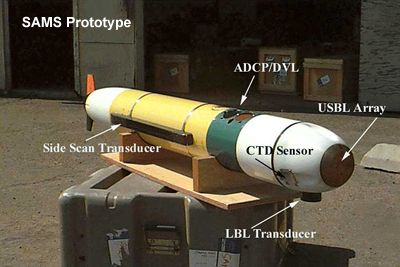
Hoo We Tak u0308352 An Autonomous Underwater Vehicle (AUV) is a robot which travels underwater. These vehicles are usually battery powered and can operate in water as deep as 6000 meters with operating radius of 10 Kilometers. These robots are different from ROVs as these vehicles are fully automated contrast to ROVs which are controlled from the surface by an operator/pilot via an umbilical.

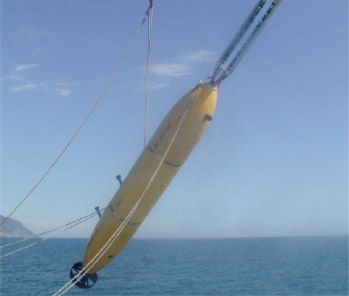
In today’s underwater exploration, AUVs can be use as a oceanographic tools. By using the sensors mounted on the robot, the robot can navigate itself. Most of the AUVs today make use of the Global Positioning System (GPS) technology. These AUVs work in conjunction with surface vessels for navigational purposes. One of these AUVs is underwater gliders is capable of operating unattended for days or weeks, periodically relaying data by satellite to shore, before returning to be picked up due to its ultra low power consumption. When a surface reference such as a support ship is available, ultra-short baseline (USBL) positioning is used to calculate the location of the subsea vehicle relative to the known (GPS) position of the surface craft by means of acoustic range and bearing measurements. Some other longer range AUVs even have GPS mounted on itself to take its own GPS fix. In between position fixes and for precise maneuvering, an inertial navigation system onboard the AUV measures the acceleration of the vehicle and Doppler velocity technology is used to measure rate of travel. These observations are filtered to determine a final navigation solution using localization algorithms.

MTS underwater gliders by University of California, San Diego

Some AUVs also make use of sensors such as compasses, depth sensors, sidescan and other sonars, magnetometers, thermistors and conductivity probes. These robots employ the technique called Simultaneous Localization and Mapping (SLAM). The SLAM AUVs starts navigation with no prior information and using only onboard sensors, to move through its environment and build a consistent map of its surroundings as well as an estimate

of its own trajectory. These AUVs is becoming more and more popular since there is no wide-coverage underwater GPS equivalent exists (although some small oil and mineral rich areas are well populated with acoustic beacons at surveyed locations).

AUV developed by MIT that uses SLAM

Reference

http://www-pord.ucsd.edu/~rdavis/publications/MTS_Glider.pdf

http://cml.mit.edu/~jleonard/pubs/ISRR2003NewmanLeonard.pdf

Robotic Surgery to the rescue

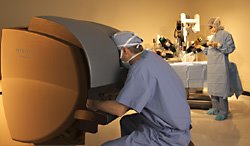
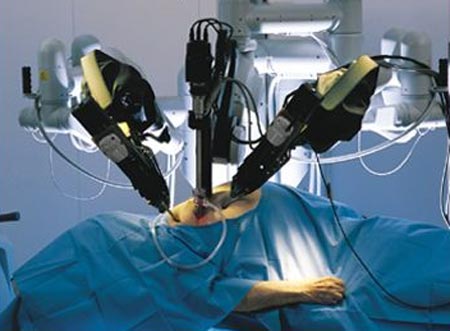
U0204500 Ong Phian Ting Surgery has always been an intimidating experience for those who have to go through it. Just imagine another person standing beside you and cutting you up, not knowing if they will make a mistake in the process. The though alone is enough to send shiver down one’s spine. Fortunately, advance in robotic has come to the rescue of these patient. The Da Vinci Surgical System from Intuitive Surgical Inc is an assistant to a surgeon during surgery. It acts as an extension to the surgeon’s hand. Instead of the surgeon holding the tools that go into the patient’s body, the robotic arms now hold the tools, while the surgeon control the arms through remote control. A video showing the overview of the system could be view at http://www.intuitivesurgical.com/products/da_vinci_video_overview.aspx The advantage of the system is numerous to both patient and surgeon. It allows the surgeon to virtually place their hands inside the patient without the need for large incisions. This minimizes the chances of the surgeon making a mistake that could harm the patient or even cause fatality. At the same time, it also helps patient to heal faster due to the smaller incisions. Another advantage is that surgeons can now scale, or ratio, their finger movement to that of the robotic arms. A movement of inches at the console can be scaled down to centimeters in the patient. This gives great control and precision to the surgery. The system also re-introduces precision to an elderly surgeon, who has all those years of experience but has lost some dexterity. The world first surgery using this system could be view at http://www.stronghealth.com/services/surgical/roboticvideo.cfm References: http://www.intuitivesurgical.com/products/davinci_surgicalsystem/index.aspx http://futurefeeder.com/index.php/archives/2005/07/07/da-vinci-robot-surgery-system

Tuesday, March 14, 2006

RoboDoc is getting cheaper... and may soon take house calls

By: U0204550 Wong Liang Mian

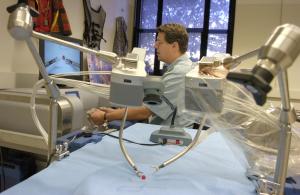
Visualize this. You were in a severe car accident while taking a vacation in the countryside. Your internal organs were traumatized and you were admitted into the nearest medical establishment. Unfortunately, it’s just a small clinic serving mostly outpatient services, with no expertise in ER trauma. Fortunately, they have a RoboDoc, a surgical robot which is controlled by consultingdoctors over the internet to perform the simple surgeries required by the clinic. Immediately, a call was made to get the next available trauma surgeon to synchronize with the RoboDoc. The operation was carried out. Your life was saved. The above scenario may sound far fetch, but it could soon become a reality.

Medical robotics has been in the limelight in the past half a decade. They are not true robots, being unable to perform tasks autonomously. Rather, they are tools which magnify the surgeon’s abilities by improving dexterity and accuracy while at the same time, make the procedures safer. In fact, the first medical robot (Intuitive Surgical’s Da Vinci Systems) has been approved and in use in the USA since July 2000. [1]

Traditionally, there are four hurdles which impeded the tele-surgery described in the opening passage. These are high cost, poor portability, inability to palpate and limitations to communications. The Da Vinci Systems cost about $1 millions each. The high cost makes it prohibitive to smaller medical establishments as well as prevents widespread implementation of the standard. The current systems are also large and complex, requiring a large operating room as well as a long setup time, which makes impromptu usage of the machine impractical [2]

Encouragingly, a mechanical engineering professor Dr. William Peine from Purdue University is collaborating with a group of doctors in an effort to develop cheaper, less complex, more portable and more versatile medical robots[3] According to his explanation, the current medical robots available are complex to accommodate the most difficult procedures. However, the majority of surgical procedures do not require such complexity and hence there is a need for a less complex robot that can handle most surgeries. Furthermore, by reducing the complexity, the size and cost of the robot can be reduced too. Setup times would also be reduced, allowing for impromptu use of the robot as required. The estimated cost of the developed robot is only one quarter of the existing systems.

As mentioned previous, two other hurdles in implementing tele-surgery would be inability to palpate and limitations to communications. One limitation of the minimally invasive surgery utilized by robots would be that the doctor would be unable to touch the patient’s tissue and use his sense of touch to diagnose the situation (palpation). [4] This prevents doctors from being willing to do tele-surgery. On another note, there is a reason why at present, the doctors situated themselves close to the medical robot. It is because the doctors can’t afford any delay in communications that might resulted in the robot lagging during the operation. [5]

Currently, to resolve the issues of robots being unable to convey the sense of touch, Dr Peine is planning to incorporate tactile sensors which would generate a color coded computer map to inform the surgeon of the textures the robot is “feeling”.

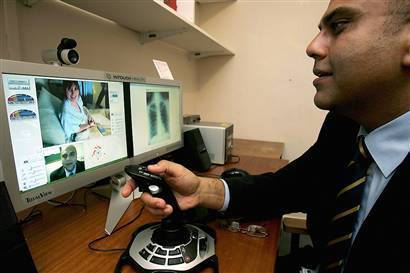
As for the question of communications, Imperial College London has a trial program of using robots to cover ward rounds.[6] They have used robots to enable busy surgeons to give their patients post surgery care despite not being with them physically. Using a wireless network within the hospital, these robots have video cameras for the surgeon to do a visual inspection of the operation wounds. Various other medical instruments such as pressure meters and thermometers also allow the surgeon to make proper medical judgments. Although this does not resolve the issue of the communications lag, it does show that a framework to use robots as mobile representatives of the doctors is being developed and ready to be advanced into the next stage once reliable internet communications can be established.

Given the advances in wireless technology and the increasing bandwidth of the internet, it is not hard to imagine the medical robots being developed by Dr Peine merging with the rudimentary observation robots currently used by the Imperial College of London. How far fetch does RoboDoc seem to be now?

[1], [5] http://electronics.howstuffworks.com/robotic-surgery1.htm

[2], [4] http://www.sciencedaily.com/releases/2006/03/060306113436.htm

[3] http://www.purdue.edu/

[6] http://www.medicalnewstoday.com/medicalnews.php?newsid=24650

SIRIUS : Modular climbing robot for service-sector applications

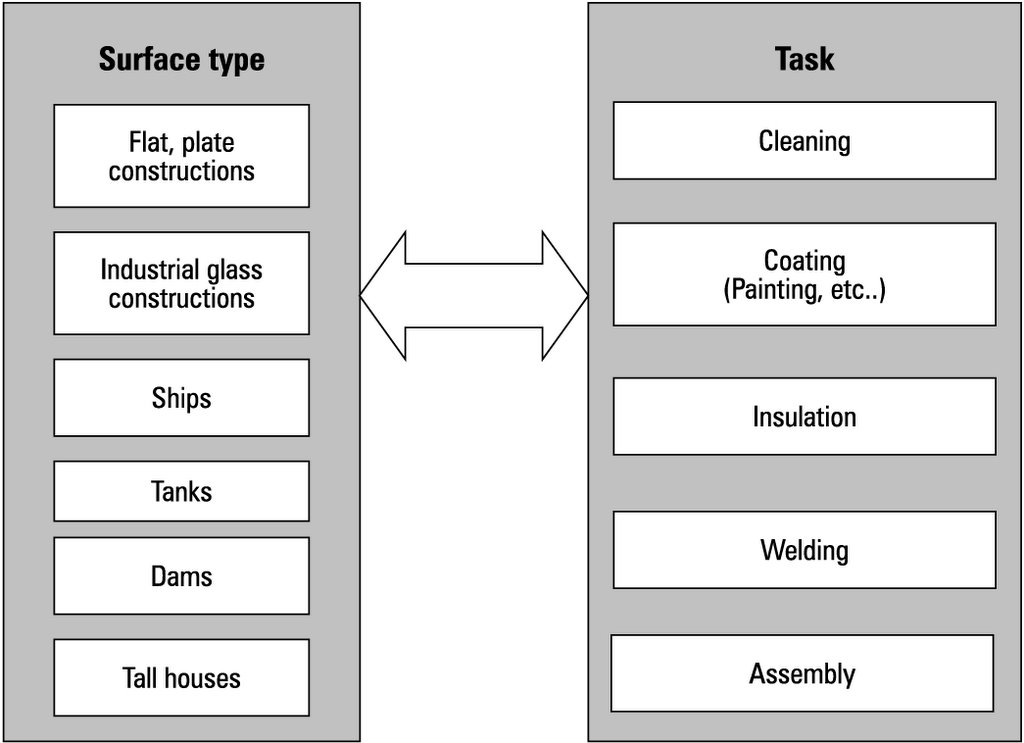
U0300654 Li Junbin SIRIUS is an autonomous climbing robot intended for moving on any vertical surface, regardless of the angle. The robot can be equipped with tools to execute many of the service-sector tasks such as façade cleaning, building and ship coating, ship welding, inspection work on tanks, and so on. It is a modular system, and the robot can adapt to almost any surface, independent of the surface material or obstacles. The robot stays attached to the surface via suction cup feet or magnetic grippers, and moves vertically on four linear guides that are coupled in two pairs. The new kinematics of the robot allow it to walk continuously in all directions. The robot overcomes obstacles by sensing their position and generating the necessary step length in order to maximize the number of suction cups attached to the surface while walking over the obstacle. Basically, SIRIUS cleans one vertical panel at a time, cleaning as it goes up so as to not leave any tracks. It starts at the top and travels quickly down the side of the façade. In the next phase, it walks up the façade, cleaning it along the way. After cleaning an entire vertical strip, SIRIUSC is then moved sideways by the gantry and begins the process anew on the next panel of the façade. The robot can clean up to 120 metre square per hr, including the time it takes to move the robot down and sideways on the façade. Besides that, SIRIUS has linear guides that are 1.2m long, and is capable of overcoming obstacles up to one meter long. On the top of that, other tools can be mounted on the robot to perform different tasks on the surface. A very sophicated cleaning tool is used by SIRIUS, which is outfitted with special features to aid in cleaning of facades. Due to the fact that there is difficulty in supplying water through a hose when cleaning a tall building, hence the water is located in an on-board water tank. The cleaning tool performs competently and with brushes and water. Furthermore, it is also environmental-friendly. On the top of that, after the glass has been cleaned, the water is not dripped down as it is drawn off the facade surface through a vacuum pump, filtered and then reused.
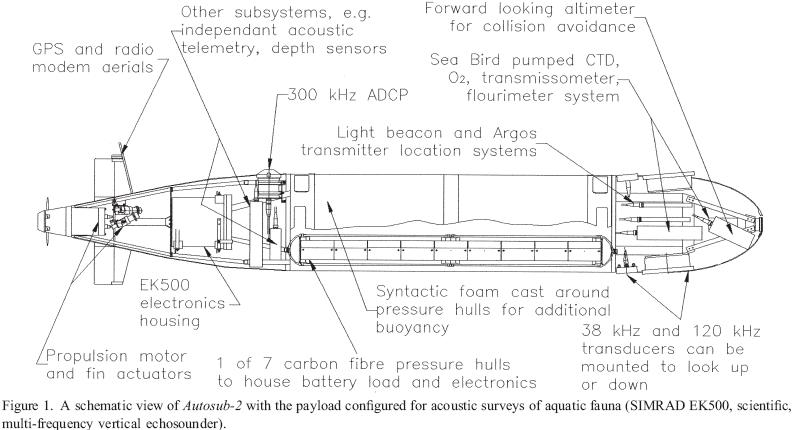
Autonomous underwater vehicles: future platforms for fishery industry

U0300643 Cheong Chong Kiat Underwater vehicles had been around for 2 centuries or more and the fishery industry starts way back before civilization where people hunt for food on land, above sky and under the sea. Nowadays, this high-tech automation combined with this traditional industry forms a potential industry or even new research area like monitoring endangered species of marine mammals (in ecosystem studies)or predicting huge catch in the monsoon season (assessment of fish stock). Autonomous underwater vehicles (AUV) are today new development of underwater vehicle that can be classified as manned or unmanned systems. AUVs are programmed to execute some underwater “missions” that may involve danger to the human if they are the ones to conduct these tasks. Deep under the sea, there are unforeseen undercurrents that are beyond people imagination. With the typically small, quiet, and have the potential to operate at low cost and be unconstrained by the vagaries of weather AUV, people can remotely view the events going on in the dark and murky environment while they are above sea. Time and money are wisely spent on improving system such as acoustic system and communication link from the target (school of fish) to the person who monitor via the Unmanned Undersea Vehicle (UUV). After gathering the data and information and through detail analysis, the UUV is retrieved back for regular maintenance and next inspection for the next bout. UUV are truly the best right-hand “man” in the fishery industry and even research on fishery science for the universities. [1]http://www.ausi.org/publications/PopaEtal2004.pdf [2]http://www.ausi.org/publications/SeaTechSolar.pdf [3]http://www.ausi.org/publications/ICRA_01paper.pdf

Expand your horizons with the iBOT Mobility System

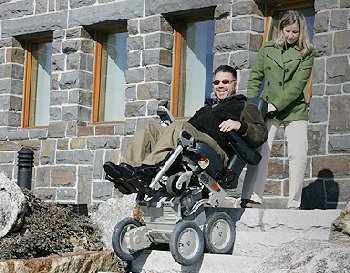
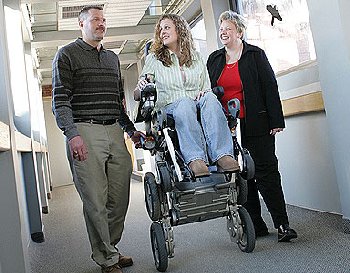
U0308345 Ng Sing Joo Assistive technology (AT), the field of innovations that removes barriers or bypasses impediments for people with disabilities, can be applied to assist people in accomplish daily tasks around the home or in a vocational setting. The revolutionary iBOT Mobility System which has a combination of features unlike any wheelchair ever created, is one excellent example of this assistive technology. The iBOT can easily power across sand, gravel or uneven terrain, climb stairs and curbs, rise to an "eye-level" position and hold a conversion, even when you are on the move.
The core of the iBot Mobility system is the patented iBalance Technology which is an integrated combination of sensor and software components and multiple computers that work in conjunction with gyroscopes. Gyroscopes are motion sensors that help maintain balance. When the gyroscopes sense movement, a signal is sent to the computers which in turn will then process the information and tell the motors how to move the wheels to maintain stability. The iBOT Mobility System constantly realigns and adjusts its wheel position and seat orientation to keep the user upright and stable at all times, even when driving up and down curbs or inclines. In addition, the iBOT® includes built-in triple redundant backup systems, as well as auditory and visual signals to provide even more safety and assurance.
While most conventional motorized wheelchairs can only travel on even surfaces, the iBOT® Mobility System powerful 4-Wheel Function allow travelling even on uneven terrain, such as grass, sand, or gravel, as well as climb curbs up to 5 inches high. This allows the user to be self independent when travelling from point to point without needing help from others.

Most conventional wheelchairs are not able to tackle stairs and thus, users find it difficult to enter buildings that do not have a ramp which is purposely built to faciliate wheelchair bound persons. However, iBOT tackles stairs easily through utilizing gyroscopes and adjusts to the driver’s center of gravity, rotating wheels up and over each other through the perfect coordinated commands of the computers inside it.

Peolple in wheel chair has to constantly strain their necks when talking to people in order to maintain eye contact due to different levels in height. They also face the problems of not being able to reach for objects that are place high onto the cupboards or shelfs. The iBOT Mobility system solves all these inconvenieces easily. The Balance Function of the iBOT can raise the user to eye level for any number of business or social interactions, even when on the move. It lets the user see over counters, and reach a high shelf in the office, kitchen or supermarket, safely and easily.
My opinion is that at the moment, this type of wheelchair would be extremely expensive and may not be affordable to the majority. However, there is still a possibilty that the through mass-produce, the product price will fall to relatively affordable levels. Thus, there are still some major issues to solve, such as costs and reliability, before these robotic wheelchairs become widely available to the masses.

RoboCart: Grocery shopping solution for the visually impaired

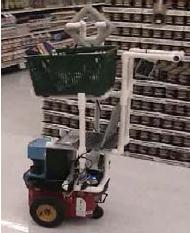
U0204714 Chan Hongjiang Human-robot interaction (HRI) has always been an exciting field of study in the area of assistive robotics; however, much of it has been based on the assumption that the human involved has visual capabilities of identifying and making use of the robot. In 2004, researchers from the Computer Science Assistive Technology Laboratory of the Department of Computer Science of Utah State University launched a project to build a robotic shopping cart for the visually impaired. The objective was to allow the visually impaired to be able to navigate and shop for grocery by themselves, with the aid of a robot. The RoboCart is designed to navigate to any location in the supermarket desired by the user. The RoboCart project takes into many considerations, most importantly of which is the ergonomical aspect of the human-robot interaction process for the visually impaired. A special handlebar with a keypad allows the user to input instructions to the shopping cart and hold on to the shopping cart for guidance with one hand only while leaving the other hand free for a guide dog or a white cane. Audio guidance is also provided to the user to pre-inform him of the direction the shopping cart is headed to next. This elegant solution was achieved only through much trial and error with various possible solutions like speech recognition, guide leash instead of a static handle, and dynamic Braille displays for output. Another area of research is how the RoboCart finds its way around the supermarket. Various solutions have been implemented for other robotic applications, including GPS, visual mapping through onboard/environment cameras, mapping through active beacons in intelligent space and so on. For the RoboCart project, the choice was a combination of position identification through RFID and line-following along the supermarket aisles. Line following is simple to implement and recent advancement in RFID has made it a very affordable technology for mass implementation. As the consumer robotics market advances, we can expect a boom in the number and types of assistive robots to be developed and marketed, catering to humans from all walks of life, for all walks of life :) References: http://cc.usu.edu/~cpg/pubs/iros05.pdf http://cc.usu.edu/~cpg/pubs/hri2006_ergo.pdf

Robot Trio of Museum für Kommunikation

U0204790 Lim Wee Kiang

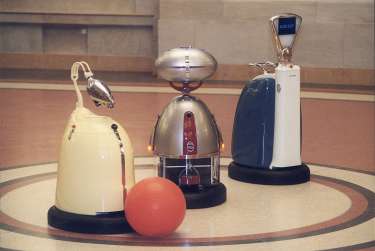
Fraunhofer (IPA), Stuttgart has designed not just 1, but 3 robots for edutainment purposes in the Museum fur Kommunikation in Berlin! Each is autonomous, differs in its manners and appearance, and has features like obstacle detection and avoidance[1]. All 3 robots make use of the data provided by the laser scanner, and the characteristic shapes and diameters of a person’s legs and the distances between them are assessed using fuzzy logic.

In order to obtain its location, the robot uses a 2D laser scanner to determine its distance from the objects around it within a radius of 180 degrees. This is assisted by odemetric encoders – which measures distance traveled on two wheels [2] and a gyroscope for determining he direction the robot is facing. I reckon that if the locality radius is increased to include the full 360 degrees it will make the robot even more sensitive to the environment.

A differential drive allows the robots to turn on the spot and eight 12 volt batteries enable the robots to operate for more than ten hours a day. What about the off-peak or quiet hours of the day? I figured it would be better having the robot “rest” in a sunlight-exposed area, to tap on solar energy and alternate between cell and solar power for greater cost efficiency though.

The robots communicate by radio Ethernet and can engage in entertainment activities like finding a ball that can be “kicked” around the museum by the robots. I sure hope valuable artifacts have remained unscathed!!

The “Inciting” (centre) welcomes visitors to the museum. Whenever he “sees” new visitors, he drives towards them and warmly welcomes them to the museum. The robot can also tell the difference between individuals and groups. Using its laser sight, “The Inciting” can store positions of people and detect new visitors. This will allow the robot to behave in the correct manner to the appropriate visitors.

The “Instructive”(right) gives a guided tour in the museum, and while doing so she moves her head so that she “looks” at the exhibits she is talking about. On her screen she shows pictures and videos which underline the explanations. An improvement could be installing Bluetooth devices on her so that visitors can use their mobile devices to download museum information or maps.

The “Twiddling”(left) behaves like a child. It plays with a ball and welcomes people to join in, while making bleeping sounds to express its current feelings. By analyzing the laser scanner data, changes in the shape of the ball can be determined. This prevents the robot from bumping into visitors. If the robot cannot find the ball, it moves around at random and searches for the ball.

In essence, the “Inciting” and “Instructive” are very useful edutainment tools but the idea of “Twiddling” playing around with the children does not seem to be very apt for a museum environment. Over-excited young children may fall or get hurt trying to attract the attention of the robot. Perhaps its function could be changed to dispensing brochures, museum souvenirs, collar pins or balloons for young children while retaining its character as a cheerful playful child.

[1] http://www.care-o-bot.de/english/MuseumRobots.php

[2] http://www.answers .com/topic/odometry?method=8

Monday, March 13, 2006

Robot Patrolling Strategy and a recent development

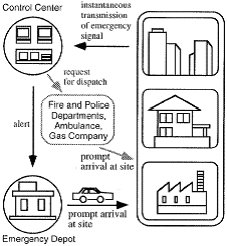
U0300641 Yeo Choon Wee Robot has been used to provide security cover for many reasons. Fundamentally, robot reduces the cost of security patrol as human cost is expensive and the life of the patroller is at risk when there are potential hazards like confronting with an armed intruder or gas leak. By having robots on patrol, the current state of the site under surveillance can be monitored by having humans in the control center and timely reports of dangerous situation can be detected and information send back to the control centre. Alarms can be set off to inform the operator of the situations e.g. fire, gas-leaks, intruder, etc… who will react accordingly. The control could be linked to Police stations, fire stations or even hospital for remedy actions as seen in the figure on the left. [1]
A robot patrolling strategy could be divided into navigation, vision manipulation, emergency sensing and communication. Navigation could be autonomous along pre-determine routes or controlled by operator remotely. The operator understands the surrounding of the robot through the camera system mounted on the robot. The robot vision can be wide view or the operator can use special eye glasses to see the stereoscopic vision as shown in the figure on the left. [1] Using the sensors equipped, the robot can be use to detect heat, smoke, intruder, etc… A list of sensors is shown in figure below.[2] Some sensors that aid the robot in maneuvering are bumper sensors, laser and CCD camera, and laser range finder for localization. Bumper sensors around the robot also provide cushion when knocked against walls, objects or even human in accordance to the rule robot is program to. Data collected from the robots is sent via communication networks to the control center.
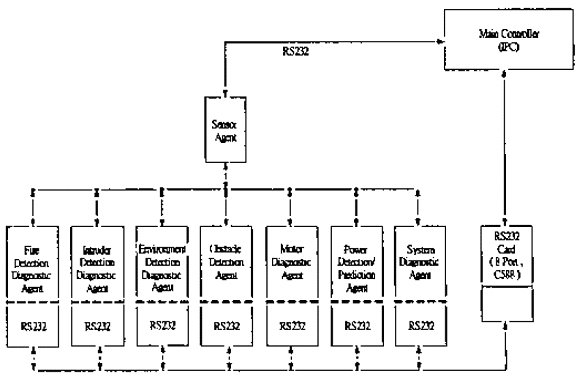
In recent years, Agent technology has been an actively research field for artificial intelligent. An agent perceives the database to be sufficient. It is able to communicate with other agents, and is selfish to pursue its own goals assigned to benefit the user. Under changing condition, an agent must equip with the knowledge of its expected surroundings, goals and behavior and the ability to create new situation specific coordination plans when these expectations are not met. Advantage of having agent system includes the use of distributed resources, performing multiple goals concurrently and reduces the risk of a single point of failure. The use of different agent combination is use to make different decisions for example, temperature sensors, smoke sensors and flame sensors are use to detect fire occurrence while touch sensors, glass sensors, sound sensors and infrared is use to detect intruder. An example of agent system can be seen the figure below.[2]

Last year, spherical robot is made by Swedish start up company which is robust and can travel on harsh terrain like mud and snow. An animation showing how the robot works is at http://rotundus.se/animation.mpg The pendulum in the sphere controls the movement of the sphere for example swinging the pendulum to left causes the sphere to move left and swinging to the right will cause it to move right. The company is working towards detecting intruder using the robot. By adding GPS sensor, wide angle camera, information can be fed back to the controller. Being spherical, it is less likely to be stuck in a particular area. Future improvement will be driving the sphere upslope as it will face difficulty in moving up stairs. A figure of the sphere robot is as shown on the left.
[1] E-journal -A Mobile Robot Testbed with Manipulator for Security Guard Application
[2] E-journal- A Multiagent Multisensor Based Real-Time Sensory Control System for Intelligent Security Robot

Security robot PatrolBot

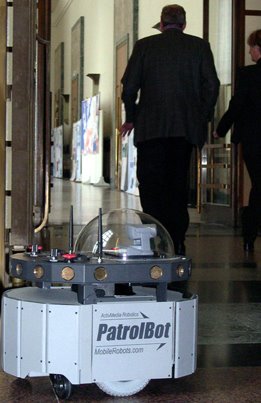
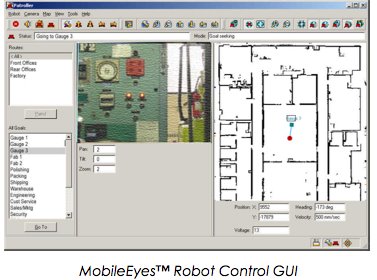
U0205025 Diana Gobeawan PatrolBot is a programmable autonomous general purpose Service robot rover built by MobileRobots Inc. They are intended for remote surveillance and security tasks. PatrolBot can scan buildings, create floor plans and navigate them autonomously using a laser range-finding sensor inside the robot. It searches for alternative paths if a hall is blocked, circumnavigates obstacles and re-charges itself at its automated charge station as needed. As a Wi-Fi device, it can operate autonomously or be controlled remotely. As a robotic base used to integrate with security alarms, automated buildings and other enterprise systems in a facility, it is programmable for custom applications, but also offers applications for surveillance, security, sensor monitoring, hazard detection and delivery. The device provides remote viewing and 2-way audio communication via PatrolBot’s MobileEyes GUI (consisting of camera, microphone and speakers). It can be controlled manually or autonomously from networked control stations. PatrolBot’s special eye-safe laser-rangefinder displays “footprints” of intruders walking by, even in darkness. A gas sensor reads oxygen, CO2 and H2S levels and can sound alarm on the robot and/or at the control station if acceptable levels are exceeded; likewise for smoke and temperature. PatrolBot verifies false alarms, instructing intruders to scan their IDs within a prescribed time to avert alarms and further investigation.

Sunday, March 12, 2006

QRIO, The Sony Dream Robot

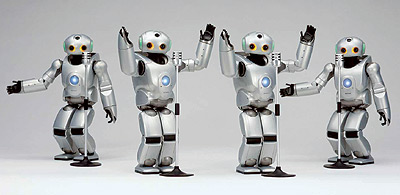
U0300657 Yeo Choon Kwang Sony Corporation has developed a small biped-walking robot, QRIO(SDR-4XII), approximately half the size of a human being. Despite its small size, it packs amazing capability and makes use of cutting-edge technology. For motion control, QRIO makes use of a newly-developed “Real-time Integrated Adaptive Control System” and real-time gait pattern generation control. These technologies enable a stable smooth gait for autonomous walking, as well as walking on irregular or/and tilted surfaces in real time. Moreover, the robot is able to maintain its posture when subjected to external pressure. In order for QRIO to execute the necessary motions, there is a need to interact with the environment. To achieve this, it makes use of “Real-world Space Perception Technology”. The hardware includes 2 CCD cameras and 7 microphones embedded in its head. The cameras enable it to gauge the distance between itself and the object and perceive the figuration of the object. Using this information, it plans a path so as to avoid the object. When a sound is detected, the strategically positioned microphones allow it to compute the direction of the source of that sound. On top of that, QRIO incorporates multi-modal human interaction technology. This includes (1) individual person detection, recognition learning technology, (2) continuous speech recognition and unknown vocabulary acquisition, (3) conversation, performance control technology based on its short-term and long-term memory and (4) speech synthesis and singing voice production.

Monkeys Control Robotic Arm with Brain Implants

U0308347 Qui Wei Loong Monkeys Control Robotic Arm with Brain Implants Scientists in North Carolina have built a brain implant that lets monkeys control a robotic arm with their thoughts, marking the first time that mental intentions have been harnessed to move a mechanical object The experiments use monkey to control a robot arm through the use of their thoughts. This is a clear indication that in the close future we can look into the possible use of robotics part for the disable. The experiments is led by Miguel A.L. Nicolelis from the Duke University in Durham, N.C published today in the journal PLoS Biology, the latest in a progression in mind controlled robotics parts in only science fiction-like movies. [1] This bodes well for the success of brain-machine interfaces. Till now the achievement of mind control machine is only limited to virtual actions like moving a cursor or typing to a computer screen which is basically a 2 dimension task. The monkey is able to learn to control robotic in a 3 dimension task like reaching for an object grasping it and even adjust the amount of strength of the grip. "This is where you want to be," said Karen A. Moxon, a professor of biomedical engineering at Drexel University in Philadelphia. "It's one thing to be able to communicate with a video screen. But to move something in the physical world is a real technological feat. And Nicolelis has taken this work to a new level by quantifying the neuroscience behind it." The devices use tiny electrodes, each one thinner than a human hair. The tiny wires were directly stuck about 1 mm into the monkey brain (ouch, I think they need to work on this part) and patched the skull using dental cement. The monkeys were unaffected by the surgery but are curious about the wires that are sticking out of their head. The wires are hooked to a computer and on to a large mechanical arm. The training of the monkey is done by placing the monkey and the arm in separate room to prevent the monkey from being frightened by the robotic arm. The monkeys were given joystick to control the arm to grab a cup of juice. They were rewarded with juice if they are successful in grabbing with the right amount of strength and moving the cup. The computer recorded the brain activity and record the animal's neural firing patterns was now serving as an interpreter, decoding the brain signals according to what it had learned from the joystick games and then sending the appropriate instructions to the mechanical arm. After the computer got good record of the brain activity, the joystick was unplugged. The monkey kept moving the joystick, not realizing that her own brain was now solely in charge of the arm's movements. Then, he said, an amazing thing happened. The animal was controlling the robot with its thoughts. There were initial signs that there was a decline in performance but just a day of further training the control become so smooth like is it the monkey’s own arm"It's quite plausible that the perception is you're extended into the robot arm, or the arm is an extension of you," agreed the University of Washington's Fetz, a pioneer in the field of brain-controlled devices. John P. Donoghue, a neuroscientist at Brown University developing a similar system, said paralyzed patients would be the first to benefit by gaining an ability to type and communicate on the Web, but the list of potential applications is endless, he said. The devices may even allow quadriplegics to move their own limbs again by sending signals from the brain to various muscles, leaping over the severed nerves that caused their paralysis. [1] "Once you have an output signal out of the brain that you can interpret, the possibilities of what you can do with those signals are immense," said Donoghue, who recently co-founded a company, Cyberkinetics Inc. of Foxboro, Mass., to capitalize on the technology. 1http://www.washingtonpost.com/ac2/wp-dyn/A17434-2003Oct12?language=printer

Friday, March 10, 2006

Robots at war: What would Asimov have to say?

U0204993 ANG KIM HWA KELVIN That high technology equipment like security/surveillance robots can do much to reduce the exposure of human troops in military and counter-terrorism events [1] make them very captivating subjects. For instance, in the famous novel Deception Point, author Dan Brown conceived the idea of the Delta Force remotely monitoring scientists using very small bug-like devices known as microbots (micro robots). In the real world, defense forces have moved beyond Unmanned Aerial Vehicles (UAV) and started exploring the potential of land-based armed reconnaissance robots. For example, the United States deployed robot soldiers called the Special Weapons Observation Reconnaissance Detection Systems (SWORDS) during the recent war in Iraq. Human US soldiers were able to operate these robots from a distance and minimized their risks of getting caught by the enemy. Essentially, SWORDS, developed by Engineering and Technology development firm Foster-Miller, is a hybrid of a small arms weapons platform mounted on a Talon robot [2]. The weapons system are interchangeable (M16, M240, M249, Barrett 50 cal, 40 mm grenade launcher or M202 anti-tank rocket systems) [3]. The Talon robot is an all-terrain, all-weather tracked vehicle with day/night capability. The system has an effective control range of 1,000 metres with firing range about 2,000 metres [2]. It runs off lithium batteries, Singars rechargeable batteries, or fixed power supplies. The control box weighs about 30 pounds, with two joysticks that control the robot platform and the weapon and a daylight viewable screen. The robot can travel at a maximum speed of 6.6 km/h. However, firing accuracy is compromised at higher speeds. The weaponised Talon is a non-autonomous single-agent robot. It is controlled through RF or fiber optic link from an attaché-sized operator control unit (OCU) or wearable OCU being by a soldier watching from up to a mile away [3] . Vision and sensory activities are achieved through an array of cameras which can include both night and thermal vision. However, it is not unforeseeable that upcoming variants of the Talon can be autonomous. Indeed, if co-operative behaviours can be achieved efficiently, multiple autonomous Talon robots might just be the way future wars are fought. In Singapore, it is unclear whether SWORDS is being used by the Singapore Armed Forces. However, Chief of Army, Major-General Desmond Kuek, said that the army has established a battalion equipped with an integrated sensory network with mini-UAVs and robotics to enhance intelligence collection and situation awareness [1]. Other countries like France are also looking into developing integrated electronic soldier systems. In the light of changes in the way wars are fought (such as Urban warfare), it becomes imperative that countries conduct research and utilize security and surveillance robots because they minimize casualties and present strategic possibilities to armies. These robots also offer a higher leverage for smaller armed forces. However, the deviant use of robotics at war remains a concern. One genuine fear is that autonomous military robots can be used "for things good soldiers just won't do" - such as allowing extremely high collateral death toll of civilians in order to kill a few unidentified or difficult targets, or demolition of buildings occupied by non-civilians [4]. Lastly, as we appreciate the benefits of military robots to the user, it might also be interesting to recall the Law of Robotics, the first of which states that “A robot may not injure a human being or, through inaction, allow a human being to come to harm” [5]. What would Asimov have to say?

Wednesday, March 08, 2006

Brains and Muscles of Industrial Robots!

U0300637 Choo Peng Yeow

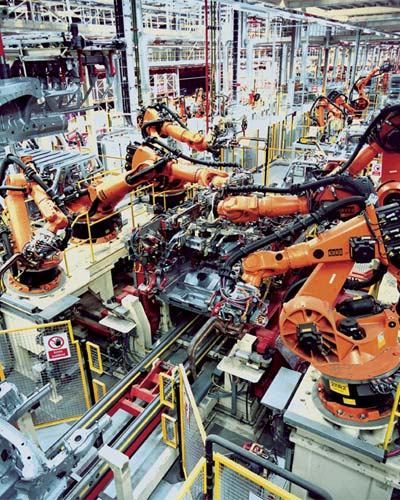
Robots are utilized in many industries where the environment is hazardous or when the company wants to reduce manpower with automation. Some examples of these industries are automobile industries, semiconductor industries, food industries, nuclear industries, power line maintenance industries and many more. This is because utilizing robots could (1) reduces health risk, (2) improve safety, (3) improve availability by allowing maintenance to take place during operations instead of halting operations, (4) access areas unreachable by human, and (5) shorten mean time to repair by reducing the response time to failures.[1]

Currently, the most common type of robots in the industrial / service field is the articulated robot (robotic arm). There are various grade of robotic arms, from 2-axis – to reach any point in a plane, 3-axis – to reach any point in a space, up to 6-axis (addition of roll, pitch and yaw axis) robotic arm. The more the number of axis the robotic arm has, the more flexible is the robotic arm. A sophisticated robotic arm is capable of moving from side-to-side, up-and-down and even 360 degree which a human arm may not be able to perform.

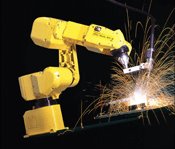
Robotic arms are built to operate in high precision, high speed and heavy duty performances which again even a human arm could not achieve. Robotic arms are used in the vast number of industries, ranging from welding, painting, ironing, assembly, pick and place, product inspection, testing, material handling, packaging, palletizing and many more. Furthermore, more sophisticated industrial robots would also have artificial intelligence and video on them which are linked to powerful computers giving the robots machine visions and therefore capable of better precision guidance.

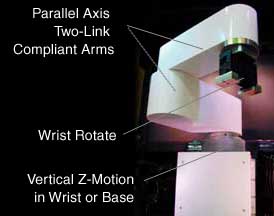
One of the applications for industrial robots is in the electronic printed circuit board (PCB) industry which uses robot arms to place very small components (Surface Mounted Devices (SMD)) on the PCB accurately precise at a very fast pace. As the component size reduces, it is difficult to use human labor for this task due to human-error such as misplace of components and accuracy of placement. The most commonly used robot arm in this industry is the popular Selective Compliant Articulated/Assembly Robot Arm (SCARA) [2], a 4-axis industrial robot as it offers best price/performance ratio as regarding speed. The SCARA is commonly used in the PCB industry because the SCARA provides an advantage for assembly operations, e.g., inserting a round pin in a round hole without binding.

The SCARA has three moving axis (X, Y and Z) and a fourth axis of motion (Theta-Z) for wrist rotation. The SCARA arm is slightly compliant in the X-Y direction but rigid in the Z direction, Hence the term Selective Compliant and the advantage for assembly operations as mentioned above. The movement of the joints is done using motors or hydraulic actuators connected to the controller which allow programming of the various control parameters such as accelerations, velocity, deceleration, and distance of a series of coordinated motions.

It has been more than 4 decades that robots are utilize in industries and it is gaining even more popularity due to the various benefits it can give. The most important benefit, I believe, is definitely cost savings and yet capable of achieving maximum throughput for the company that uses robots. This is because the robots could operate non-stop 24 hours a day, 7 days a week with occasional halt for maintenance. The robots utilized in the industries are becoming the driving force for future technology. It has become an indispensable component in the modern industries.