 u037028m Azhar Risyad Sunaryo
(Picture: Reborg-Q in action)
Reborg-Q, product of a Japanese company, ALSOK, is designed to boost security of a place. It can patrol a pre-defined path or controlled by joystick using wheels underneath.
While on patrol, the robot will take a look at the surroundings using its sensors that can detect water leaks, fire, or humans. If one of the sensors, for example the fire sensor, is alarmed, the robot will deviate from its path and follow the source. It then sends an alert to the computer in the security room and with four cameras on its head and shoulders, send the video of the problem. The person in the security room will then decide what to do, for example extinguish the fire using fire extinguisher that can be equipped on it. These videos can record anything during its patrol and the image will be sent via wi-fi to the security room.
With the help of monitor on its chest, it can also provide various informations, such as the location's map. This will help lost children or for shoppers to find a way to their destination. Armed with a voice synthesizer, it can tell the time, weather or even make a promotional announcement. The robot can also ask for identification using a card reader equipped on its shoulders.
With all the applications above, this robot can surely enhance the safety of a building. It indeed gives a new height to the shopping experience.
u037028m Azhar Risyad Sunaryo
(Picture: Reborg-Q in action)
Reborg-Q, product of a Japanese company, ALSOK, is designed to boost security of a place. It can patrol a pre-defined path or controlled by joystick using wheels underneath.
While on patrol, the robot will take a look at the surroundings using its sensors that can detect water leaks, fire, or humans. If one of the sensors, for example the fire sensor, is alarmed, the robot will deviate from its path and follow the source. It then sends an alert to the computer in the security room and with four cameras on its head and shoulders, send the video of the problem. The person in the security room will then decide what to do, for example extinguish the fire using fire extinguisher that can be equipped on it. These videos can record anything during its patrol and the image will be sent via wi-fi to the security room.
With the help of monitor on its chest, it can also provide various informations, such as the location's map. This will help lost children or for shoppers to find a way to their destination. Armed with a voice synthesizer, it can tell the time, weather or even make a promotional announcement. The robot can also ask for identification using a card reader equipped on its shoulders.
With all the applications above, this robot can surely enhance the safety of a building. It indeed gives a new height to the shopping experience.
Thursday, April 05, 2007
Have a great and safe shopping experience with Reborg-Q
u037028m Azhar Risyad Sunaryo
(Picture: Reborg-Q in action)
Reborg-Q, product of a Japanese company, ALSOK, is designed to boost security of a place. It can patrol a pre-defined path or controlled by joystick using wheels underneath.
While on patrol, the robot will take a look at the surroundings using its sensors that can detect water leaks, fire, or humans. If one of the sensors, for example the fire sensor, is alarmed, the robot will deviate from its path and follow the source. It then sends an alert to the computer in the security room and with four cameras on its head and shoulders, send the video of the problem. The person in the security room will then decide what to do, for example extinguish the fire using fire extinguisher that can be equipped on it. These videos can record anything during its patrol and the image will be sent via wi-fi to the security room.
With the help of monitor on its chest, it can also provide various informations, such as the location's map. This will help lost children or for shoppers to find a way to their destination. Armed with a voice synthesizer, it can tell the time, weather or even make a promotional announcement. The robot can also ask for identification using a card reader equipped on its shoulders.
With all the applications above, this robot can surely enhance the safety of a building. It indeed gives a new height to the shopping experience.


The Wine-tasting Robot
 As we all know, robots are now becoming more helpful in humans daily life. This wine-tasting robot could discriminate between wine types. However, the test condition is still limited: the sensor has to touch surface of the wine and it must be clean.
The robot then will work by transmitting infrared rays at the wine and degree of absorption of certain wavelengths would be measured by the robot. According to the absorbance spectrum obtained from the wine, the robot could estimate the most components of the wine, such as sugar and fat. Then this information will send to the database it had, the database eventually will tell the robot what kind of wine it is. The robot now finishes it tasting job.
Tasting wine is not only hard for human,but also quite chanllenging for robots. This is because the differences in absorbance spectra among different types of wine are really small to differ. The cleanness of the sensor will decide the accuracy of the results.
Hence, the future development for such a robot is to improve the infrared sensor to make it with a wider spectrum that may covers the range from near-infrared rays to the mid-infrared spectrum.
reference:
Yu Zhenyu
U037786A
As we all know, robots are now becoming more helpful in humans daily life. This wine-tasting robot could discriminate between wine types. However, the test condition is still limited: the sensor has to touch surface of the wine and it must be clean.
The robot then will work by transmitting infrared rays at the wine and degree of absorption of certain wavelengths would be measured by the robot. According to the absorbance spectrum obtained from the wine, the robot could estimate the most components of the wine, such as sugar and fat. Then this information will send to the database it had, the database eventually will tell the robot what kind of wine it is. The robot now finishes it tasting job.
Tasting wine is not only hard for human,but also quite chanllenging for robots. This is because the differences in absorbance spectra among different types of wine are really small to differ. The cleanness of the sensor will decide the accuracy of the results.
Hence, the future development for such a robot is to improve the infrared sensor to make it with a wider spectrum that may covers the range from near-infrared rays to the mid-infrared spectrum.
reference:
Yu Zhenyu
U037786A
"A robot may not injure a human being, or, through inaction, allow a human being to come to harm."
Kevin Brown
NT061428J
Isaac Asimov's first law of robotics [1] seems certain to be broken in the near future. Military applications of robotics have poured many millions of dollars into unmanned air and ground vehicles, as well as smaller, armed robots. Most of the armed unmanned vehicles, however, lie under the ultimate control of a human. With the most government military (except Korea) currently wary to give control of the trigger to silicon, the first 'First Law' transgressor may have been designed by an amateur just out of college.
In the summer of 2006 Aaron Rasmussen, freshly graduated from Boston University in the US, decided to do something to make him stand out to employers. He had a friend manning a turret in Iraq and it inspired him to design a sentry gun. “I thought, my friend is risking is life for no apparent reason,” he said. [2]
 Image provided by http://www.thesentrygun.com/
The gun essentially tracks and aims for the heart (with no higher level choice of target beyond recognizing a human). Rasmussen programmed the vision systems using Microsoft's DirectShow technology and utilizing the OpenCV library. The camera is an everyday webcam. The gun is an FN P90 and it tracks with servo motors controlled by four bar linkage. The computing power is provided by an external computer.
There is commercial interest in the gun. USMechatronics has begun working toward production under the auspices of SEIS group.
The sentry gun he designed shoots 6 mm ball bearings, not bullets, and Rasmussen says he is of the dangers presented. The bottom of his site, which details how he built the gun, reads "Don't Die Disclaimer: Don't use these plans, derivations of the gun, or anything to hurt people. In fact, don't hurt people."
Citations:
[1] "Runaround" by Isaac Asimov
[2] http://www.bu.edu/phpbin/news-cms/news/?dept=4&id=37650
http://www.thesentrygun.com/
http://www.technovelgy.com/ct/Science-Fiction-News.asp?NewsNum=502
Image provided by http://www.thesentrygun.com/
The gun essentially tracks and aims for the heart (with no higher level choice of target beyond recognizing a human). Rasmussen programmed the vision systems using Microsoft's DirectShow technology and utilizing the OpenCV library. The camera is an everyday webcam. The gun is an FN P90 and it tracks with servo motors controlled by four bar linkage. The computing power is provided by an external computer.
There is commercial interest in the gun. USMechatronics has begun working toward production under the auspices of SEIS group.
The sentry gun he designed shoots 6 mm ball bearings, not bullets, and Rasmussen says he is of the dangers presented. The bottom of his site, which details how he built the gun, reads "Don't Die Disclaimer: Don't use these plans, derivations of the gun, or anything to hurt people. In fact, don't hurt people."
Citations:
[1] "Runaround" by Isaac Asimov
[2] http://www.bu.edu/phpbin/news-cms/news/?dept=4&id=37650
http://www.thesentrygun.com/
http://www.technovelgy.com/ct/Science-Fiction-News.asp?NewsNum=502
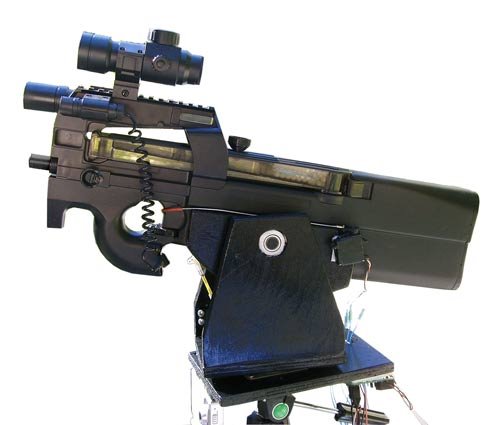 Image provided by http://www.thesentrygun.com/
The gun essentially tracks and aims for the heart (with no higher level choice of target beyond recognizing a human). Rasmussen programmed the vision systems using Microsoft's DirectShow technology and utilizing the OpenCV library. The camera is an everyday webcam. The gun is an FN P90 and it tracks with servo motors controlled by four bar linkage. The computing power is provided by an external computer.
There is commercial interest in the gun. USMechatronics has begun working toward production under the auspices of SEIS group.
The sentry gun he designed shoots 6 mm ball bearings, not bullets, and Rasmussen says he is of the dangers presented. The bottom of his site, which details how he built the gun, reads "Don't Die Disclaimer: Don't use these plans, derivations of the gun, or anything to hurt people. In fact, don't hurt people."
Citations:
[1] "Runaround" by Isaac Asimov
[2] http://www.bu.edu/phpbin/news-cms/news/?dept=4&id=37650
http://www.thesentrygun.com/
http://www.technovelgy.com/ct/Science-Fiction-News.asp?NewsNum=502
Image provided by http://www.thesentrygun.com/
The gun essentially tracks and aims for the heart (with no higher level choice of target beyond recognizing a human). Rasmussen programmed the vision systems using Microsoft's DirectShow technology and utilizing the OpenCV library. The camera is an everyday webcam. The gun is an FN P90 and it tracks with servo motors controlled by four bar linkage. The computing power is provided by an external computer.
There is commercial interest in the gun. USMechatronics has begun working toward production under the auspices of SEIS group.
The sentry gun he designed shoots 6 mm ball bearings, not bullets, and Rasmussen says he is of the dangers presented. The bottom of his site, which details how he built the gun, reads "Don't Die Disclaimer: Don't use these plans, derivations of the gun, or anything to hurt people. In fact, don't hurt people."
Citations:
[1] "Runaround" by Isaac Asimov
[2] http://www.bu.edu/phpbin/news-cms/news/?dept=4&id=37650
http://www.thesentrygun.com/
http://www.technovelgy.com/ct/Science-Fiction-News.asp?NewsNum=502
Robotic Haptic Interface
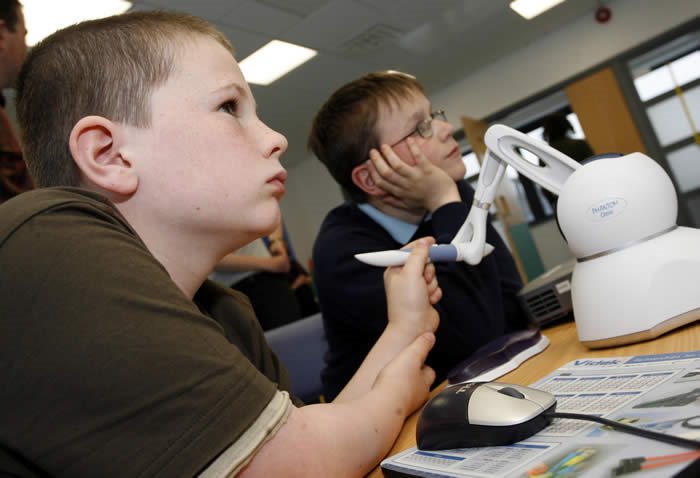 Perhaps not as well-known as other types of disabilities, but Developmental Coordination Disorder (also known as dyspraxia) has caused difficulties for about 5% of the children in mastering coordination tasks, such as catching a ball, tying shoelaces and standing on one foot. Recent robotic research and development has come up with a device to teach coordination to children who having such problem.
 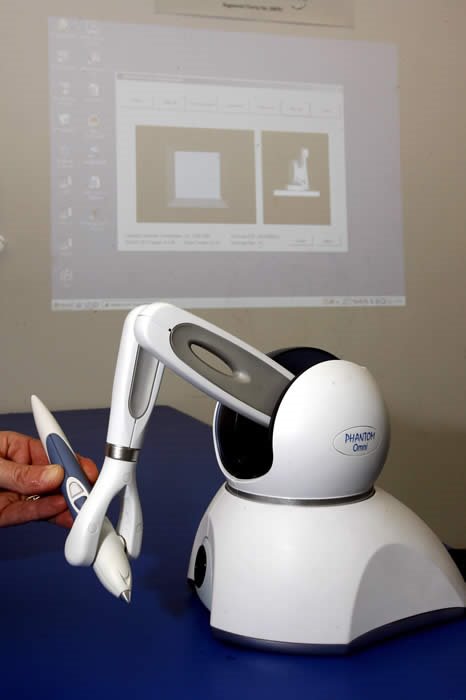 Firstly, certain tasks will be designed by therapists to challenge the eye-hand coordination of individuals. One example is handwriting. The children will hold the robotic arm and perform the task shown on the screen. The robotic arm will follow designed trajectories and provide resistance, thus simulate the effort that is required to perform such task. The robotic arm joined with the computer is known as a robotic haptic interface that incorporate the sense of touching to help children develop their eye-hand coordination. The user will be able to “feel” the virtual environment that is shown on the screen.
With this equipment, the children can practice their coordination repeatedly in interesting tasks. This type of robotic therapy becomes a popular research area in rehabilitation robotics. The pictures show the prototype of such robot in performing handwriting task. Further research and development will enhance such system to perform more complicated tasks.
Jin Peng
U036569E
Firstly, certain tasks will be designed by therapists to challenge the eye-hand coordination of individuals. One example is handwriting. The children will hold the robotic arm and perform the task shown on the screen. The robotic arm will follow designed trajectories and provide resistance, thus simulate the effort that is required to perform such task. The robotic arm joined with the computer is known as a robotic haptic interface that incorporate the sense of touching to help children develop their eye-hand coordination. The user will be able to “feel” the virtual environment that is shown on the screen.
With this equipment, the children can practice their coordination repeatedly in interesting tasks. This type of robotic therapy becomes a popular research area in rehabilitation robotics. The pictures show the prototype of such robot in performing handwriting task. Further research and development will enhance such system to perform more complicated tasks.
Jin Peng
U036569E
Wednesday, April 04, 2007
The World's First Expressive Computer
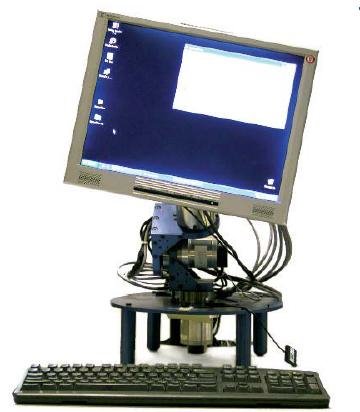 RoCo, the world’s first expressive computer is a robotic computer has a monitor for a head and a simple LCD screen for a face. It expresses itself by using its double-jointed neck, which is equipped with actuators that shift the monitor up and down, tilt it forward and back and swivel it from side to side, An attached camera can detect when its user moves, allowing RoCo to adjust its posture accordingly. RoCo’ was being built, in hope that by responding to a user’s changes in posture, people might be more likely to build up a “rapport” with the computer that will make sitting at a desk all day a little more enjoyable. RoCo’s powers of expression might be harnessed by tuning into users’ moods; the robot might help them get their work done more effectively.
Previous studies have shown that someone’s emotional state can dramatically affect their performance on analytical tasks and that posture can play a role in this; hence in this project, the researchers are looking into how the robot might affect users’ posture while working. RoCo could be programmed to adopt the right posture to foster greater attention and persistence in children, or simply to help improve people’s posture when sitting at a desk. In future, the group also plans to investigate programming RoCo to mimic the posture and gestures of its users, to see if that builds rapport and enhances engagement with the computer, as such behavior is known to do between humans.
Tng Thomson U046231A
RoCo, the world’s first expressive computer is a robotic computer has a monitor for a head and a simple LCD screen for a face. It expresses itself by using its double-jointed neck, which is equipped with actuators that shift the monitor up and down, tilt it forward and back and swivel it from side to side, An attached camera can detect when its user moves, allowing RoCo to adjust its posture accordingly. RoCo’ was being built, in hope that by responding to a user’s changes in posture, people might be more likely to build up a “rapport” with the computer that will make sitting at a desk all day a little more enjoyable. RoCo’s powers of expression might be harnessed by tuning into users’ moods; the robot might help them get their work done more effectively.
Previous studies have shown that someone’s emotional state can dramatically affect their performance on analytical tasks and that posture can play a role in this; hence in this project, the researchers are looking into how the robot might affect users’ posture while working. RoCo could be programmed to adopt the right posture to foster greater attention and persistence in children, or simply to help improve people’s posture when sitting at a desk. In future, the group also plans to investigate programming RoCo to mimic the posture and gestures of its users, to see if that builds rapport and enhances engagement with the computer, as such behavior is known to do between humans.
Tng Thomson U046231A
Integrating Exploratory Algorithms Using Multiple Cooperative Robots with land/sea/aerial/underground Exploratory Robots
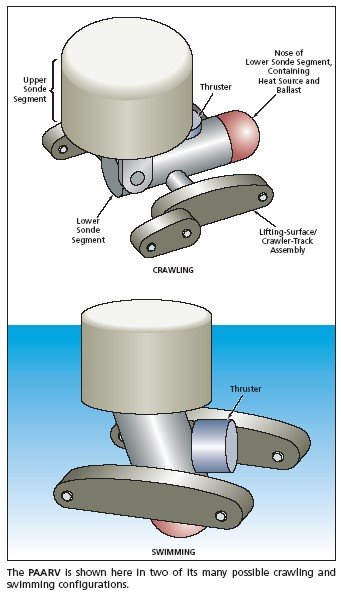 Recent times fall upon eager enthusiasm of the scientific community to explore other planets and moons in the solar system. With the Cassini space craft inspecting Saturn and its moon Titan and with various plans to explore and even terraform Mars, many minds around the world are dedicating to developing robots and algorithms to achieve such exploration on a feasible and efficient scale. The following is just my idea of bringing together many technologies and concepts that have been previously proposed. The materials present here are all referenced from http://www.techbriefs.com/.
I believe using multiple robots with various forms of locomotion not confined to just solid ground would be most advantageous for exploration. For terrestrial exploration, why not use amphibious robots? The Planetary Autonomous Amphibious Robotic Vehicle (PAARV), in its prototype stage, is a merging of prior ice-penetrating exploratory robots and the designs of drop sondes used on Earth for scientific and military purposes [1].
Recent times fall upon eager enthusiasm of the scientific community to explore other planets and moons in the solar system. With the Cassini space craft inspecting Saturn and its moon Titan and with various plans to explore and even terraform Mars, many minds around the world are dedicating to developing robots and algorithms to achieve such exploration on a feasible and efficient scale. The following is just my idea of bringing together many technologies and concepts that have been previously proposed. The materials present here are all referenced from http://www.techbriefs.com/.
I believe using multiple robots with various forms of locomotion not confined to just solid ground would be most advantageous for exploration. For terrestrial exploration, why not use amphibious robots? The Planetary Autonomous Amphibious Robotic Vehicle (PAARV), in its prototype stage, is a merging of prior ice-penetrating exploratory robots and the designs of drop sondes used on Earth for scientific and military purposes [1].
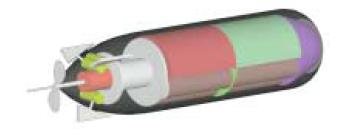
In addition, the PAARV can be made to carry such miniature robot submarines as the miniature autonomous submersible explorer (MASE), that are built to explore extreme environments such as sub-glacial lakes, deep-ocean hydrothermal vents, acidic or alkaline lakes, brine lenses in permafrost, and ocean regions under Antarctic ice shelves [2].
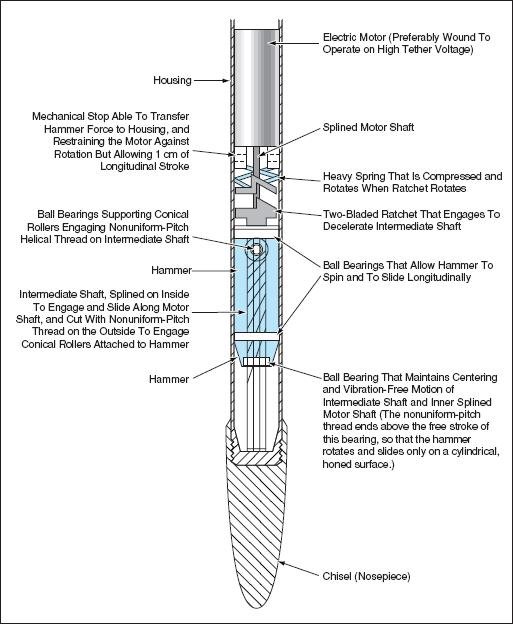 For subsurface exploration, robots such as the Subsurface Explorer (SSX) that uses a mechanism similar to an optimized jackhammer can be deployed when necessary [3].
Now the crucial question: how does one determine when and where each of these robots is necessary? It would be easy to say, “Survey an area first, analyze the obtained data and carry out further explorations”. However, what if radio communication with earth is not always available? One solution may be to enhance communication networks by employing multiple relay points from ground units as well as airborne drones. Systems such as "Bioinspired Engineering of Exploration Systems" (BEES) [4] can be used, which mimic natural explores like honey bees to develop algorithms.
 A more robust system would be to actually assign the role of leader to a drone and let the companion of robots act as a ‘herd’ in exploring the terrain [5]. The designated leader would issue commands to move the robots to different locations or aim sensors at different targets to maximize scientific return. Here, a potential field approach can be used to identify places of interest and obstacles and map them to an artificial ‘field map’, and genetic algorithm can be employed such that the herd could be regarded as consisting of a set of artificial creatures that evolve to adapt to a previously unknown environment. The development of this exploration method is still underway and theoretical testing is being carried out.
[1] Mobile Robot for Exploring Cold Liquid/Solid Environments
[2] Miniature Robotic Submarine for Exploring Harsh Environments
[3] Sub-surface Explorer Robot with
[4] Cooperative Lander-Surface/Aerial Microflyer Missions for Mars Exploration
[5] Controlling Herds of Cooperative Robots
Curious Dogs
 The Aibo is a popular robot dog designed to interact with its owner and perform simple tricks. In Sony's R&D lab, all these new Aibo dogs were given two software control mechanisms. Firstly, a "low-level learning system" that controls simple behavior and also tries to predict how those behaviors will affect the surrounding sensory. Secondly, a "meta-learning system" that analyses the accuracy of predictions made by the low-level system and controls the overall “motivation”.
Interaction between these two components is critical to the reprogrammed Aibos' uncannily inquisitive nature. The meta-learning system prompts the robot dogs to pursue behaviors that they can rapidly learn to predict, but which also have maximum learning potential. This tends to makes the robot dogs inherently curious, seeking out increasingly complicated scenarios with which to interact. However they will effectively become bored with activities that do not stimulate them to their artificial satisfaction.
In an experiment, these robotic pups are placed in a child's activity-pen and were left alone for investigation. It was observed that the robots learned progressively; initially just moving their limbs in an uncoordinated manner, followed by exploring their surroundings and biting nearby soft toys. After several hours, these dogs started kicking their toys and even trying to interact with conventional Aibo dogs. Although every subject followed a similar learning pattern, but the results showed that there were variations among the Aibos’ pattern. This research could eventually help robot designers to create machines that are much more flexible and adaptive in unpredictable circumstances.
Tng Thomson U046231A
The Aibo is a popular robot dog designed to interact with its owner and perform simple tricks. In Sony's R&D lab, all these new Aibo dogs were given two software control mechanisms. Firstly, a "low-level learning system" that controls simple behavior and also tries to predict how those behaviors will affect the surrounding sensory. Secondly, a "meta-learning system" that analyses the accuracy of predictions made by the low-level system and controls the overall “motivation”.
Interaction between these two components is critical to the reprogrammed Aibos' uncannily inquisitive nature. The meta-learning system prompts the robot dogs to pursue behaviors that they can rapidly learn to predict, but which also have maximum learning potential. This tends to makes the robot dogs inherently curious, seeking out increasingly complicated scenarios with which to interact. However they will effectively become bored with activities that do not stimulate them to their artificial satisfaction.
In an experiment, these robotic pups are placed in a child's activity-pen and were left alone for investigation. It was observed that the robots learned progressively; initially just moving their limbs in an uncoordinated manner, followed by exploring their surroundings and biting nearby soft toys. After several hours, these dogs started kicking their toys and even trying to interact with conventional Aibo dogs. Although every subject followed a similar learning pattern, but the results showed that there were variations among the Aibos’ pattern. This research could eventually help robot designers to create machines that are much more flexible and adaptive in unpredictable circumstances.
Tng Thomson U046231A
ProVar
 U0303509 Varun Agarwala
In order to help people who have physical disabilities like tetraplagia, a Professional Vocational Assistant Robot, or ProVar for short, was developed, which would aid them to move physical objects. This system allows these people to create and execute daily chores and vocational supports using a function known as Activities of Daily Living.
The robot uses a novel user interface and dynamic control environment for robust and safe manipulation. It has an arm, mounted overhead a motorized track, which can execute tasks required by the user. The user can see a preview of the task on a workstation to confirm if that is exactly what he or she wants. The system uses a 3-dimentional model to combine task creation and manipulation. The system has the capability to act according to a user’s specific physical disabilities by using various adaptive devices, specified by the ADL. It can be used for getting medication, drinks, papers handling etc. In short, it has enough functions for a disabled person to remain comfortable in the absence of an assistant and most importantly, remain independent.
The use of this device on test subjects confirmed its ease of use as well as a variety of functions specified by the user’s themselves. After just a couple of training sessions, the users were able to use the device without much difficulty and this device should prove to be a big boon for physically disabled humans.
The Pipeline Explorer
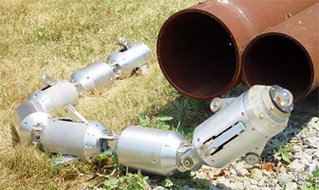
This little fellow explores a different kind of environment - natural gas pipelines.
Introducing....
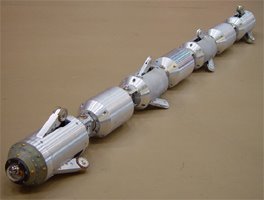 The Pipeline Explorer!
The battery powered remote-controlled Explorer can perform long ranged inspections of gas pipelines, conveying images back to the operator via a wireless link.
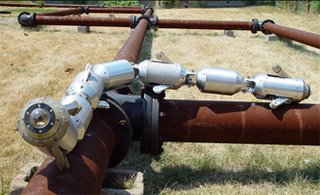
The Explorer's architecture consists of a seven segment body. Specially designed joints allows the robot to manuever itself in any direction it needs within the pipe. The CPU unit and electronics are protected in purged and pressurized housings.
The locomotor module houses a mini 190 degree field-of-view camera, equipped with lenses and lighting. It also houses 3 retractable legs, which are equipped with custom molded driving wheels. The robot can reach cruising speeds of 4 inches per second.
The Pipeline Explorer!
The battery powered remote-controlled Explorer can perform long ranged inspections of gas pipelines, conveying images back to the operator via a wireless link.
The Explorer's architecture consists of a seven segment body. Specially designed joints allows the robot to manuever itself in any direction it needs within the pipe. The CPU unit and electronics are protected in purged and pressurized housings.
The locomotor module houses a mini 190 degree field-of-view camera, equipped with lenses and lighting. It also houses 3 retractable legs, which are equipped with custom molded driving wheels. The robot can reach cruising speeds of 4 inches per second.
 Many pipelines over the world are aging, and increasing checks are needed to detect water intrusions and other defects. The Explorer system can access thousands of feet of pipeline from a single excavation, making it far superior to any other conventional methods used in terms of speed and costs.
 The Explorer won an R&D Magazine Top 100 award in 2006 for being one of the year’s most original and innovative technological developments.
References:
http://www.technovelgy.com/ct/Science-Fiction-News.asp?NewsNum=732
http://www.rec.ri.cmu.edu/projects/explorer/
http://www.rec.ri.cmu.edu/projects/explorer/application/index.htm
Huang Zhengyang
U037752U
The Explorer won an R&D Magazine Top 100 award in 2006 for being one of the year’s most original and innovative technological developments.
References:
http://www.technovelgy.com/ct/Science-Fiction-News.asp?NewsNum=732
http://www.rec.ri.cmu.edu/projects/explorer/
http://www.rec.ri.cmu.edu/projects/explorer/application/index.htm
Huang Zhengyang
U037752U
 The Pipeline Explorer!
The battery powered remote-controlled Explorer can perform long ranged inspections of gas pipelines, conveying images back to the operator via a wireless link.
The Explorer's architecture consists of a seven segment body. Specially designed joints allows the robot to manuever itself in any direction it needs within the pipe. The CPU unit and electronics are protected in purged and pressurized housings.
The locomotor module houses a mini 190 degree field-of-view camera, equipped with lenses and lighting. It also houses 3 retractable legs, which are equipped with custom molded driving wheels. The robot can reach cruising speeds of 4 inches per second.
The Pipeline Explorer!
The battery powered remote-controlled Explorer can perform long ranged inspections of gas pipelines, conveying images back to the operator via a wireless link.
The Explorer's architecture consists of a seven segment body. Specially designed joints allows the robot to manuever itself in any direction it needs within the pipe. The CPU unit and electronics are protected in purged and pressurized housings.
The locomotor module houses a mini 190 degree field-of-view camera, equipped with lenses and lighting. It also houses 3 retractable legs, which are equipped with custom molded driving wheels. The robot can reach cruising speeds of 4 inches per second.
 Many pipelines over the world are aging, and increasing checks are needed to detect water intrusions and other defects. The Explorer system can access thousands of feet of pipeline from a single excavation, making it far superior to any other conventional methods used in terms of speed and costs.
 The Explorer won an R&D Magazine Top 100 award in 2006 for being one of the year’s most original and innovative technological developments.
References:
http://www.technovelgy.com/ct/Science-Fiction-News.asp?NewsNum=732
http://www.rec.ri.cmu.edu/projects/explorer/
http://www.rec.ri.cmu.edu/projects/explorer/application/index.htm
Huang Zhengyang
U037752U
The Explorer won an R&D Magazine Top 100 award in 2006 for being one of the year’s most original and innovative technological developments.
References:
http://www.technovelgy.com/ct/Science-Fiction-News.asp?NewsNum=732
http://www.rec.ri.cmu.edu/projects/explorer/
http://www.rec.ri.cmu.edu/projects/explorer/application/index.htm
Huang Zhengyang
U037752U
doctor, i think i have a robot in my intestines
 They say it is going to be the world's first microbot to be able to swim through arteries and the digestive system.
They are an international team of scientist who are working on a robot that has a width of 2 human hairs. The leader of the team is James Friend, who is a scientist at the Micro/Nanophysics Research Laboratory at Australia's Monash University.
This robot is so small that it is able to swim through many organs such as the heart, and is able to perform 'minimally invasive microsurgeries', according to Friend. The robot is designed to be able to transmit images from inside the human body; and also deliver microscopic payloads to parts of the body which is outside the reach of current technologies.
For example, the robot is able to release a payload of microscopic glue onto a damaged brain artery. Usually this process is highly dangerous because these brain arteries are situated behind complicated sets of bend at the base of the skull. Only the most flexible catheters can possibly reach these places. To make matters worse, any puncture of these arteries will be fatal.
The robot is administered to the human body through a syringe and guided by remote control. Once it has completed its missions within the body, it can return to the point of entry and be extracted by a syringe.
The possible potential of this microbot extends to region of the body that current technology cannot reach. Patients with stroke, embolism and vascular-disease should, according to the scientist, be the first to benefit from this robot.
This microbot's design is inspired by the E. coli bacterium, with flagella to propel it through the body. The initial materials used for the flagella are human hair, but later plans are directed towards using Kevlar.
The breakthrough in this robot is the propulsion system. Within the micromotor, Friend and his team are exploiting the use of piezoelectric materials-- crystals that give off electric charges when mechanically stressed. These crystals vibrate a twisted micromechanism within the robot at ultrasonic frequencies. This process eventually leads to a rotor rotating and thus propelling the system.
Video of the actuator:
In the case the motor breaks down, the plan is to extract the robot at the entry point. Thus it needs to be inserted and controlled to swim upstream of the blood.
Currently the scientist are working at the micro device in charge of delivering the imaging and deliver the payloads. Scheduled for a completed version in 2009, there are already larger prototypes of the motor ready, which is about the size of a grain of sand.
Friend also needs the public's help in naming the robot.
article at http://www.wired.com/medtech/health/news/2007/01/72448
Sim Jian Ping
U036080A
They say it is going to be the world's first microbot to be able to swim through arteries and the digestive system.
They are an international team of scientist who are working on a robot that has a width of 2 human hairs. The leader of the team is James Friend, who is a scientist at the Micro/Nanophysics Research Laboratory at Australia's Monash University.
This robot is so small that it is able to swim through many organs such as the heart, and is able to perform 'minimally invasive microsurgeries', according to Friend. The robot is designed to be able to transmit images from inside the human body; and also deliver microscopic payloads to parts of the body which is outside the reach of current technologies.
For example, the robot is able to release a payload of microscopic glue onto a damaged brain artery. Usually this process is highly dangerous because these brain arteries are situated behind complicated sets of bend at the base of the skull. Only the most flexible catheters can possibly reach these places. To make matters worse, any puncture of these arteries will be fatal.
The robot is administered to the human body through a syringe and guided by remote control. Once it has completed its missions within the body, it can return to the point of entry and be extracted by a syringe.
The possible potential of this microbot extends to region of the body that current technology cannot reach. Patients with stroke, embolism and vascular-disease should, according to the scientist, be the first to benefit from this robot.
This microbot's design is inspired by the E. coli bacterium, with flagella to propel it through the body. The initial materials used for the flagella are human hair, but later plans are directed towards using Kevlar.
The breakthrough in this robot is the propulsion system. Within the micromotor, Friend and his team are exploiting the use of piezoelectric materials-- crystals that give off electric charges when mechanically stressed. These crystals vibrate a twisted micromechanism within the robot at ultrasonic frequencies. This process eventually leads to a rotor rotating and thus propelling the system.
Video of the actuator:
In the case the motor breaks down, the plan is to extract the robot at the entry point. Thus it needs to be inserted and controlled to swim upstream of the blood.
Currently the scientist are working at the micro device in charge of delivering the imaging and deliver the payloads. Scheduled for a completed version in 2009, there are already larger prototypes of the motor ready, which is about the size of a grain of sand.
Friend also needs the public's help in naming the robot.
article at http://www.wired.com/medtech/health/news/2007/01/72448
Sim Jian Ping
U036080A
Remote Presence Robots In ICU
 Wu Ronghua U036423A
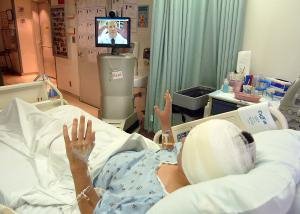
Having Remote Presence Robots in the neurosurgery intensive care unit(ICU) is the way to allow doctors to communicate more conveniently with the patients, family members and the staffs. As there is a serious lack in intensivists, the physicians who specialize in the care of critically ill patients, these RP-6 mobile robots proved to be helpful to extend the reach of the intensivists. These robots provide more "presence" of the physicians. The robot is about 5-foot-6-inch tall robot and displays the physician face on the monitor screen. The patient then will interact, speaks and hears with the physician through these robots. The robots can also move closer to the patients and zoom in on the patients or the monitors at the side, move to the patient’s record, X-rays, test reports to facilitate the doctors to view them. The physicians can do all this with the control of a joystick in either in their office or even at home. The presence of these intensivists is said to improve patients to reduce care, thereby reducing the stay of the patients and also the cost of their staying. These robots can also allow patients to access directly to medicals experts around the world so that they seek medical advice from them. They can also allow patients to interact with doctors who have performed their surgery, even if the doctors cannot be physically at the patient's bedside. Through surveys, such robots have been well received and some patients even prefer such robots to real doctors.
Wu Ronghua U036423A
Having Remote Presence Robots in the neurosurgery intensive care unit(ICU) is the way to allow doctors to communicate more conveniently with the patients, family members and the staffs. As there is a serious lack in intensivists, the physicians who specialize in the care of critically ill patients, these RP-6 mobile robots proved to be helpful to extend the reach of the intensivists. These robots provide more "presence" of the physicians. The robot is about 5-foot-6-inch tall robot and displays the physician face on the monitor screen. The patient then will interact, speaks and hears with the physician through these robots. The robots can also move closer to the patients and zoom in on the patients or the monitors at the side, move to the patient’s record, X-rays, test reports to facilitate the doctors to view them. The physicians can do all this with the control of a joystick in either in their office or even at home. The presence of these intensivists is said to improve patients to reduce care, thereby reducing the stay of the patients and also the cost of their staying. These robots can also allow patients to access directly to medicals experts around the world so that they seek medical advice from them. They can also allow patients to interact with doctors who have performed their surgery, even if the doctors cannot be physically at the patient's bedside. Through surveys, such robots have been well received and some patients even prefer such robots to real doctors.
Meet Mr.Gromit and Mr. K-9!
Robot space explorers are good because
1) they are cheaper than sending astronauts 2) they are easier to maintain - don't get bored, tired, need food, drink or exercise. they don't even need to go to the toilet!! 3) they can be neglected in a cramped space for a long period of time. 4) they can explore dangerous planets and don't need air to breathe.Therefore, in the pursuit of strong interest on foreign planets like mars, we, human, need these advanced and intelligent robot space explorers to explore the unknown planets.
The renowned NASA then has came out with two robotic heros - Mr. Gromit and Mr. K-9. A smart robots, they claimed to be.
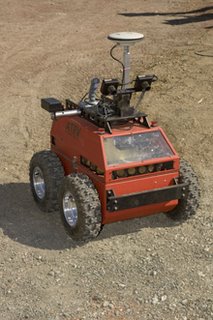
Mr Gromit A red little cubic, four-wheeled robot. Though it is small size, Mr. Gromit can navigate a rock-strewn patch of land at a stately pace of 5 centimeters (2 inches) per second. While navigating, Mr Gromit can communicate with researchers back in the lab. Most surprisingly, it can obey dutifully to the commands tasked to him.
 Mr. K-9
Mr. K-9, who is smarter and twice as fast than Mr. Gromit, uses its own built-in intelligence to navigate across the simulated Martian terrain and wheel around obstacles He is a born photographer, taking pictures of the rocks and analyzing their composition with half-minute pauses for reasoned reflection while on the trundling. Similar to Mr. Gromit, this crane-like, six wheeled robot also obeyed commands given.

So why them?
These two robots are much more complex and intelligent. In tandem of that, they are loaded with combinations of sophisticated software, cameras, spectrometers and global positioning system location-finders. In addition, they can build habitat for future human pioneering and specified the promising areas for joint human-machine exploration. The intelligence point is their ability to gauge the danger level of certain terrain. For example, they can feedback earth's researchers that the a certain region is safe for the machine, but not for human. What a caring robots, ya?
With more and more researchs weighing on the robot explorer, it is just a matter of time that these robots can eventually fully explore the Mars, build a civilisation on it and operate a "Matrix" world like us!
Koh Ling Ying
U046245WReferences: http://sfgate.com/cgi-bin/article.cgi?=/c/a/2005/10/04/MNGM7F25CD1.DTL&type=science
Border Protecting Robot
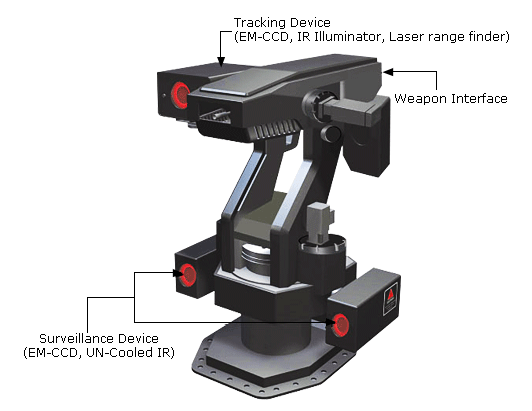 As security is getting more and more important, the use of technology to enhance the security of a country is inevitable. In South Korea, the army uses modern robots developed by Samsung Techwin called Intelligent Surveillance and Guard Robot as multi-functional security guards to protect the borders of their country whose main features are tracking, firing and voice recognition capabilities.
The robot with surveillance and tracking system utilizes the Electron Multiplying Charge Coupled Device (EMCCD), Un-cooled Infra Red (IR) Camera, IR Illuminator and Laser Range Finder which have a daytime detection range of 4km and a nighttime detection range of 2km. Its tracking capabilities are 2km during daytime and 1km during nighttime. It can even detect multiple objects as well as zooming in on the object for a clearer view. Even if the object is moving would not obstruct the tracking capabilities of the robot as the camera installed has great flexibility to turn with the object.
This newly developed robot is equipped with weapons that enhance its capabilities to actively engage suspected targets and neutralize them. The installation of various lethal or non-lethal weapons together with high precision device is important for high firing accuracy. These designs allow a threat to be neutralized easily from a distance without killing them for future investigation.
Other than that, it has sophisticated communication and voice recognition system. This reduces the risks friendly fire as the robot is able to accept passwords which can identify the suspected target as a friend or enemy. The robot can also warn the suspect to surrender instead of shooting at it if the password doesn’t match. Therefore, the robust system is ideal to avoid unnecessary injury while still being able to capture suspects.
In short, this can enhance security at the borders against hostile intrusion. Human security guard can then act behind the scenes to observe and analyze the situation before ordering the robot to take steps to neutralize the suspect.
References:
Lai Sing Zie U036919R
As security is getting more and more important, the use of technology to enhance the security of a country is inevitable. In South Korea, the army uses modern robots developed by Samsung Techwin called Intelligent Surveillance and Guard Robot as multi-functional security guards to protect the borders of their country whose main features are tracking, firing and voice recognition capabilities.
The robot with surveillance and tracking system utilizes the Electron Multiplying Charge Coupled Device (EMCCD), Un-cooled Infra Red (IR) Camera, IR Illuminator and Laser Range Finder which have a daytime detection range of 4km and a nighttime detection range of 2km. Its tracking capabilities are 2km during daytime and 1km during nighttime. It can even detect multiple objects as well as zooming in on the object for a clearer view. Even if the object is moving would not obstruct the tracking capabilities of the robot as the camera installed has great flexibility to turn with the object.
This newly developed robot is equipped with weapons that enhance its capabilities to actively engage suspected targets and neutralize them. The installation of various lethal or non-lethal weapons together with high precision device is important for high firing accuracy. These designs allow a threat to be neutralized easily from a distance without killing them for future investigation.
Other than that, it has sophisticated communication and voice recognition system. This reduces the risks friendly fire as the robot is able to accept passwords which can identify the suspected target as a friend or enemy. The robot can also warn the suspect to surrender instead of shooting at it if the password doesn’t match. Therefore, the robust system is ideal to avoid unnecessary injury while still being able to capture suspects.
In short, this can enhance security at the borders against hostile intrusion. Human security guard can then act behind the scenes to observe and analyze the situation before ordering the robot to take steps to neutralize the suspect.
References:
Lai Sing Zie U036919R
Morphing Planes
 New generation: Planes with Shape-Changing.
Unmanned Aerial Vehicles have been evolving. From the slow and bulky flying boxes, they have improved to become much smaller and quieter. Now, there's a new proposed version of it: A fast, swift and agile plane that mimics that of birds and sea gulls. It ranges from 15cm long to 60cm.
Its capabilities would include that of 'diving in between buildings, zoom under overpasses and land on apartment balconies' which often requires 'sharp turns, spins and dives'. This can be achieved by changing the shape of the wings. There were a few prototypes that were done to produce these effects, the latest having the wings capable of being transformed from down to up position. This is modeled after the sea gulls, and the prototype was capable of making that transformation in just 12 seconds. Such transformation is assisted by motors and supported by metal rods, which allows the plane to be used suitably in city landscape.
Current research now stands at improving the ease of flying such planes. This morphing plane loses stability when it is in a high maneuverability mode. Ultimate aim however would be focused on making such planes autonomous.
Such planes would be useful in the military or police or the fire and bomb-removal departments, or in cases like 24-hour surveillance for security purposes or that of monitoring potential problems in hazardous plants like nuclear power plant or oil refinery plants, etc.
New generation: Planes with Shape-Changing.
Unmanned Aerial Vehicles have been evolving. From the slow and bulky flying boxes, they have improved to become much smaller and quieter. Now, there's a new proposed version of it: A fast, swift and agile plane that mimics that of birds and sea gulls. It ranges from 15cm long to 60cm.
Its capabilities would include that of 'diving in between buildings, zoom under overpasses and land on apartment balconies' which often requires 'sharp turns, spins and dives'. This can be achieved by changing the shape of the wings. There were a few prototypes that were done to produce these effects, the latest having the wings capable of being transformed from down to up position. This is modeled after the sea gulls, and the prototype was capable of making that transformation in just 12 seconds. Such transformation is assisted by motors and supported by metal rods, which allows the plane to be used suitably in city landscape.
Current research now stands at improving the ease of flying such planes. This morphing plane loses stability when it is in a high maneuverability mode. Ultimate aim however would be focused on making such planes autonomous.
Such planes would be useful in the military or police or the fire and bomb-removal departments, or in cases like 24-hour surveillance for security purposes or that of monitoring potential problems in hazardous plants like nuclear power plant or oil refinery plants, etc.
Food Robotics
Every time when one goes to the supermarket to buy a pack of sliced meat and opened it, one can observe that the meat is nicely sliced with equal dimensions. How could humans have done that? Unless we are talking about Japanese sashimi chefs who slice fish at the highest precision, it is impossible to accomplish that feat.
We have seen how robots are used in car assembly lines. What is happening here is the introduction of robotics to the food and beverage industry. Robots have been utilized in the management of food. A pity that they are not as widely used as their assembly line counterparts. There are three main sections of food management, (1) picking, (2) packing and (3) palletizing.
 Current factory settings involve humans to filter out poorly produced items and pick the rest for packing. Different individuals may have different perceptions of poorly produced items. Their vision may differ too, thereby resulting in inconsistency of selection. With robots programmed to fixed perceptions, the inconsistency will be massively reduced. It was mentioned that vision systems determine the characteristics of the items being scanned. Meat cutting is also pre-programmed to be done at certain orientations, thereby resulting in consistency in the dimensions of the meat.
In a fast-paced competitive industry, it pays to be fast. Manual packaging takes a long time, even with a large factory workforce. With robots, this process will speed up by many folds. They can be pre-programmed to do such tasks over and over again, tirelessly and at high speeds. Moreover, they are flexible in that they can multi-task, by packaging more than one item at a time, and also to deal with a variety of packaging containers, such as boxes and trays.
Handling packed products can also be a chore when it comes to storing the packages. Some items, especially frozen food, have to be stored in places with low temperatures. Robots are able to withstand long hours in such places, thereby speeding up the process. The weights of different items may vary. Therefore, stacking a heavy item over a lighter one can be damaging. Using vision systems to inspect the items, robots can place the packages in the correct orientation so as to prevent any damage.
Current factory settings involve humans to filter out poorly produced items and pick the rest for packing. Different individuals may have different perceptions of poorly produced items. Their vision may differ too, thereby resulting in inconsistency of selection. With robots programmed to fixed perceptions, the inconsistency will be massively reduced. It was mentioned that vision systems determine the characteristics of the items being scanned. Meat cutting is also pre-programmed to be done at certain orientations, thereby resulting in consistency in the dimensions of the meat.
In a fast-paced competitive industry, it pays to be fast. Manual packaging takes a long time, even with a large factory workforce. With robots, this process will speed up by many folds. They can be pre-programmed to do such tasks over and over again, tirelessly and at high speeds. Moreover, they are flexible in that they can multi-task, by packaging more than one item at a time, and also to deal with a variety of packaging containers, such as boxes and trays.
Handling packed products can also be a chore when it comes to storing the packages. Some items, especially frozen food, have to be stored in places with low temperatures. Robots are able to withstand long hours in such places, thereby speeding up the process. The weights of different items may vary. Therefore, stacking a heavy item over a lighter one can be damaging. Using vision systems to inspect the items, robots can place the packages in the correct orientation so as to prevent any damage.
 In the beverages industry, Motoman Inc., invented RoboBar, which serves as a bartender. It can mix different kinds of drinks through dispensing guns that pump the liquor and mixes, and can also add ice, depending on the choice of the customer. Most importantly, it can perform the order in a breeze. Besides mixing alcohol, it can also whip up a sumptous cup of coffee.
With robots in the food and beverage industry, flexibility and speed can be introduced. Everything and anything can be handled and at great speed. Besides maintaining the robots, nothing else is done since the process has been pre-programmed. Since everything is automated, there will be a better distribution of the workforce to other human-specific tasks, thereby increasing the efficiency in their work. In addition to that, they can do the work of many people. Safety problems will also be reduced to a minimum. These robots certainly make us run for our money, eh?
Related Articles:
In the beverages industry, Motoman Inc., invented RoboBar, which serves as a bartender. It can mix different kinds of drinks through dispensing guns that pump the liquor and mixes, and can also add ice, depending on the choice of the customer. Most importantly, it can perform the order in a breeze. Besides mixing alcohol, it can also whip up a sumptous cup of coffee.
With robots in the food and beverage industry, flexibility and speed can be introduced. Everything and anything can be handled and at great speed. Besides maintaining the robots, nothing else is done since the process has been pre-programmed. Since everything is automated, there will be a better distribution of the workforce to other human-specific tasks, thereby increasing the efficiency in their work. In addition to that, they can do the work of many people. Safety problems will also be reduced to a minimum. These robots certainly make us run for our money, eh?
Related Articles:
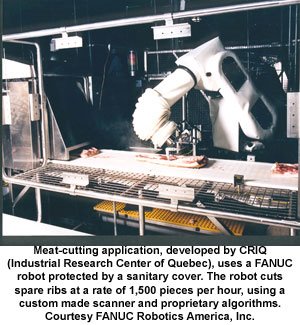 Current factory settings involve humans to filter out poorly produced items and pick the rest for packing. Different individuals may have different perceptions of poorly produced items. Their vision may differ too, thereby resulting in inconsistency of selection. With robots programmed to fixed perceptions, the inconsistency will be massively reduced. It was mentioned that vision systems determine the characteristics of the items being scanned. Meat cutting is also pre-programmed to be done at certain orientations, thereby resulting in consistency in the dimensions of the meat.
In a fast-paced competitive industry, it pays to be fast. Manual packaging takes a long time, even with a large factory workforce. With robots, this process will speed up by many folds. They can be pre-programmed to do such tasks over and over again, tirelessly and at high speeds. Moreover, they are flexible in that they can multi-task, by packaging more than one item at a time, and also to deal with a variety of packaging containers, such as boxes and trays.
Handling packed products can also be a chore when it comes to storing the packages. Some items, especially frozen food, have to be stored in places with low temperatures. Robots are able to withstand long hours in such places, thereby speeding up the process. The weights of different items may vary. Therefore, stacking a heavy item over a lighter one can be damaging. Using vision systems to inspect the items, robots can place the packages in the correct orientation so as to prevent any damage.
Current factory settings involve humans to filter out poorly produced items and pick the rest for packing. Different individuals may have different perceptions of poorly produced items. Their vision may differ too, thereby resulting in inconsistency of selection. With robots programmed to fixed perceptions, the inconsistency will be massively reduced. It was mentioned that vision systems determine the characteristics of the items being scanned. Meat cutting is also pre-programmed to be done at certain orientations, thereby resulting in consistency in the dimensions of the meat.
In a fast-paced competitive industry, it pays to be fast. Manual packaging takes a long time, even with a large factory workforce. With robots, this process will speed up by many folds. They can be pre-programmed to do such tasks over and over again, tirelessly and at high speeds. Moreover, they are flexible in that they can multi-task, by packaging more than one item at a time, and also to deal with a variety of packaging containers, such as boxes and trays.
Handling packed products can also be a chore when it comes to storing the packages. Some items, especially frozen food, have to be stored in places with low temperatures. Robots are able to withstand long hours in such places, thereby speeding up the process. The weights of different items may vary. Therefore, stacking a heavy item over a lighter one can be damaging. Using vision systems to inspect the items, robots can place the packages in the correct orientation so as to prevent any damage.
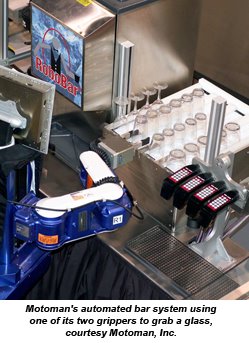 In the beverages industry, Motoman Inc., invented RoboBar, which serves as a bartender. It can mix different kinds of drinks through dispensing guns that pump the liquor and mixes, and can also add ice, depending on the choice of the customer. Most importantly, it can perform the order in a breeze. Besides mixing alcohol, it can also whip up a sumptous cup of coffee.
With robots in the food and beverage industry, flexibility and speed can be introduced. Everything and anything can be handled and at great speed. Besides maintaining the robots, nothing else is done since the process has been pre-programmed. Since everything is automated, there will be a better distribution of the workforce to other human-specific tasks, thereby increasing the efficiency in their work. In addition to that, they can do the work of many people. Safety problems will also be reduced to a minimum. These robots certainly make us run for our money, eh?
Related Articles:
In the beverages industry, Motoman Inc., invented RoboBar, which serves as a bartender. It can mix different kinds of drinks through dispensing guns that pump the liquor and mixes, and can also add ice, depending on the choice of the customer. Most importantly, it can perform the order in a breeze. Besides mixing alcohol, it can also whip up a sumptous cup of coffee.
With robots in the food and beverage industry, flexibility and speed can be introduced. Everything and anything can be handled and at great speed. Besides maintaining the robots, nothing else is done since the process has been pre-programmed. Since everything is automated, there will be a better distribution of the workforce to other human-specific tasks, thereby increasing the efficiency in their work. In addition to that, they can do the work of many people. Safety problems will also be reduced to a minimum. These robots certainly make us run for our money, eh?
Related Articles:
- http://news.thomasnet.com/fullstory/503400/2328
- http://www.robots.com/articles.php?tag=1650
- http://foodproductiondaily.com/news/ng.asp?id=66874-k-robotix-robotics-anuga
Tuesday, April 03, 2007
OFRO - First outdoor security patrol robot
 OFRO is not only the first mobile security robot worldwide used for outdoor surveillance, it also has the honour of being one of the first robots used to patrol the stadium in the World Cup. The picture to the right is of the OFRO being used in the Olympic stadium in Berlin. In that particular World Cup event, the OFRO is used alongside of another robot, the MOSRO, and both these models of surveillance robots are developed by the Berlin company Robowatch.
The OFRO can perform many functions. It is able to make use of thermal cameras to identify and locate intruders at night or at any places where visibility is low, according to their body heat. The OFRO can also be used for a wide variety of other reasons such as in the military as a scout and to detect radiation, toxins, viruses and chemical warfare agents. It is also very flexible being very much weather-proof and mobile so it is suitable to be dispatched either indoors or outdoors. It is also suitable to be used in hazard zones such as in the chemical industry or in explosive areas.
In the World Cup, the OFRO got navigation help from the Global Positioning System satellites and send pictures back to a central room in the stadium called the skybox. Through remote control, the OFRO can also be sent to check on anything suspicious.
In general, the sensor head of the OFRO is able to rotate 360° automatically with integrated thermo camera. It also has two ultrasound distance sensors, GSM module and WLAN built in. With highly sensitive sensor technology, it is able to identify intruders and react quickly. Timely action can be taken in terms of activation by a wireless signal from the OFRO.
http://www.virtualworldlets.net/Archive/IndividualNews.php?News=1311
http://www.msnbc.msn.com/id/13485246/
Goh Pei Ming
U049117N
OFRO is not only the first mobile security robot worldwide used for outdoor surveillance, it also has the honour of being one of the first robots used to patrol the stadium in the World Cup. The picture to the right is of the OFRO being used in the Olympic stadium in Berlin. In that particular World Cup event, the OFRO is used alongside of another robot, the MOSRO, and both these models of surveillance robots are developed by the Berlin company Robowatch.
The OFRO can perform many functions. It is able to make use of thermal cameras to identify and locate intruders at night or at any places where visibility is low, according to their body heat. The OFRO can also be used for a wide variety of other reasons such as in the military as a scout and to detect radiation, toxins, viruses and chemical warfare agents. It is also very flexible being very much weather-proof and mobile so it is suitable to be dispatched either indoors or outdoors. It is also suitable to be used in hazard zones such as in the chemical industry or in explosive areas.
In the World Cup, the OFRO got navigation help from the Global Positioning System satellites and send pictures back to a central room in the stadium called the skybox. Through remote control, the OFRO can also be sent to check on anything suspicious.
In general, the sensor head of the OFRO is able to rotate 360° automatically with integrated thermo camera. It also has two ultrasound distance sensors, GSM module and WLAN built in. With highly sensitive sensor technology, it is able to identify intruders and react quickly. Timely action can be taken in terms of activation by a wireless signal from the OFRO.
http://www.virtualworldlets.net/Archive/IndividualNews.php?News=1311
http://www.msnbc.msn.com/id/13485246/
Goh Pei Ming
U049117N
A Hands-Off Physical Therapy Assistance Robot for Cardiac Patients
U037841J Tan Sze Sze Vivian
Most developed countries face the problem of an aging population . This has put a strain on medical and healthcare services as this meant more medical workers are needed. The most direct implication is the shortage of nurses. The workload for existing healthcare workers are increased and methods for relieving their workload is needed. Robots that could provide assistance for repetitive yet time-consuming tasks are developed and are in high demand. They could relieve the workload of nurses and nurses could channel their efforts to greater flexibility. The robot presented in the picture below is named Clara and it provides assistance for breathing (spirometry) exercises for patients.
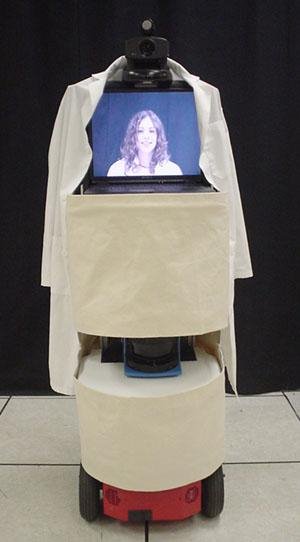
The target assistive for the robot ,Clara, is the spirometry exercise. Cardiac patients need to perform regular lung exercises after their surgery . This is to prevent infection and increase the speed of recovery. Patients inhale air through a spirometer, a small plastic device which measures the velocity and amount of inhaled air . Patients are supposed to inhale up to a specified volume of air, which will slowly increase as they recover. This exercise forces the lungs to expand and contract regularly to prevent pneumonia. This activity is usually facilitated by a nurse and has to be carried out ten times per hour for several days or weeks after the cardiac surgery. The process is repetitive, laborious and time-consuming for the nurses. Tutelage on how to use the spirometer and how to breath properly are needed in the first few sessions, subsequent sessions require mostly motivation and monitoring. Monitoring meant the recording of the patient’s progress and thus track recovery rate. Thus, in subsequent sessions after the patient has learnt how to use the spirometer and breath properly , the activity of providing spirometry exercise can be replaced by a robot.The robot will record the patient’s progress for the nurses to track their recovery.
Clara is a hands-off intelligent assistive robot as it has no physical contact with the patient. Instructions are given through speech and speech recognition is one of the implementations of the robot. 3 traits are endowed upon Clara, they are namely , social awareness, autonomy and the lack of tactile input or physical manipulation. Social awareness involves interaction with the patient, providing motivation for the specified breathing excercise ,which is painful for the patient. Autonomy means no human assistance is needed and lack of physical manipulation means it does not need a person to push it around or give it commands through physical contact. Clara is constructed with off-the-shelf products. It has acoustic perception and obstacle avoidance abilities for command and navigation. It has a video playback application that can display a person’s face.
Future work would involve improving accuracy of the speech recognition implementation and safety. Safety has to be improved as hospitals have highly dynamic environments and might hinder the robot’s ability to perform obstacle detection and avoidance. The robot could be made more interactive as well.
I feel that this robot is a good development and could benefit medical worker’s by relieving their workload a lot. More of these robots that cater for repetitive and time-consuming work could be development , not only in the medical field , but in engineering, construction fields or areas that involves high risk like space tracking. These assistive robots could help humans channel efforts to better use or perform difficult tasks in their place.
Reference : Kyong Il Kang, Sanford Freedman and Maja J Matari´c, Interaction Laboratory Computer Science Department, University of Southern California, Mark J. Cunningham and Becky Lopez,Department of Cardiothoracic Surgery,Keck School of Medicine,University of Southern California, “A Hands-Off Physical Therapy Assistance Robot for Cardiac Patients”, USC Centre for Robotics and Embedded Systems Technical Report, CRES-05-001,Mar 2005
http://robotics.usc.edu/~maja/teaching/cs584/papers/kang.pdf
RoboMusic
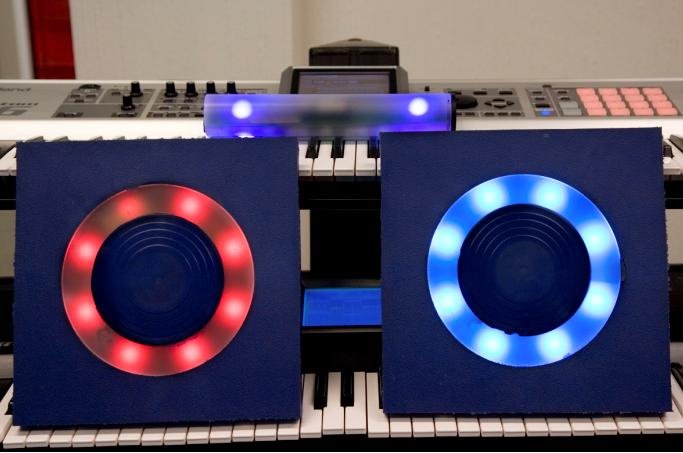 The word ‘Robots’ conjure up image of stiff human-like machines which carry out tasks according to pre-programmed specifications. Generally, it is quite hard to associate robots with something creative such as music. However, popular remix musician Martin Ottesen also known as Funkstar Deluxe came together with Professor Henrik Hautop Lund to create a new album titled ‘No Man’s Planet’ based on a revolutionizing genre of music that is created using a collaboration of musical instruments developed by robotics. These interactive musical instruments can measure touch and rolling pins that measure rotational acceleration and pressure to create variations in resonance, cut-off, volume and pan of musical tracks in the musical composition.
The inauguration concert of the album ‘No Man’s Planet’ took place as an interactive RoboMusic concert during the Robots at Play Festival on 15th September 2006 in Odense, Denmark.
The most pioneering aspect of this new musical genre is that it makes live concerts interactive for the audience. The audience can be actively engaged in the performance of the music of the concert by interacting with the musical instruments. The robotic instruments have a baseline musical behavior, which is changed upon interaction with the instrument. Interaction with the robotic instruments guides the robotic behavior and thereby creates unique live concert performances that change from concert to concert depending on the preferences and behavior of the audience. For the audience, the concert form has changed from passive listening to active participation in playing the concert.
Each RoboMusic concert becomes a unique live performance!
Enjoy RoboMusic here
The word ‘Robots’ conjure up image of stiff human-like machines which carry out tasks according to pre-programmed specifications. Generally, it is quite hard to associate robots with something creative such as music. However, popular remix musician Martin Ottesen also known as Funkstar Deluxe came together with Professor Henrik Hautop Lund to create a new album titled ‘No Man’s Planet’ based on a revolutionizing genre of music that is created using a collaboration of musical instruments developed by robotics. These interactive musical instruments can measure touch and rolling pins that measure rotational acceleration and pressure to create variations in resonance, cut-off, volume and pan of musical tracks in the musical composition.
The inauguration concert of the album ‘No Man’s Planet’ took place as an interactive RoboMusic concert during the Robots at Play Festival on 15th September 2006 in Odense, Denmark.
The most pioneering aspect of this new musical genre is that it makes live concerts interactive for the audience. The audience can be actively engaged in the performance of the music of the concert by interacting with the musical instruments. The robotic instruments have a baseline musical behavior, which is changed upon interaction with the instrument. Interaction with the robotic instruments guides the robotic behavior and thereby creates unique live concert performances that change from concert to concert depending on the preferences and behavior of the audience. For the audience, the concert form has changed from passive listening to active participation in playing the concert.
Each RoboMusic concert becomes a unique live performance!
Enjoy RoboMusic here--> http://www.e-robot.dk/robomusic/Teaser.mp3
Reference : http://www.e-robot.dk/robomusic.html
Posted by : Jaseema Banu - U036882L
WAR - Becoming a Video Game??

The superpowers in the world have long been interested in the development of defense technology to gain that competitive edge over other nations, even if it is just psychological. This pressing need for supremacy has seen funding to the tune of billions of dollars and has yielded many scientific marvels. A prime example is the Unmanned Aerial Vehicle (UAV).
A UAV is a much smaller aircraft without a pilot onboard. These robots can be remote controlled or given autonomous control based on pre-programmed flight plans or more complex dynamic automation systems. UAVs are currently used in a number of military roles, including reconnaissance and attack. The degree of autonomy of such aircrafts has been gradually increasing over the years ever since the first UAV was introduced in the 1950s. The degree of autonomy is contingent on areas like sensor fusion, motion planning, communications, trajectory generations, task scheduling and cooperative tactics. As is the case with most new inventions, the UAV can be used for a number of productive and peaceful missions but its primary application has always been in the defense sector. The
The UAV will definitely save many lives if employed in a combat situation and that was the idea behind its inception. While this invention is a great success from a scientific point of view, it adds a host of moral dilemmas. Since such aircrafts are unmanned, there is no human life factor to consider in a hostile situation, thus making it easier to go to war. Also we are still a long way off from getting robots to simulate human emotions and that is something that there is simply no substitute for. If the UAV continues development at the current rate than it wouldn't be long before it is used extensively not just for surveillance, but for combat also. We can only hope that this will not lead to more conflict between the nations as the all of mankind will have to bear the burden. The futility of war is probably best highlighted by the quote 'War seldom determines who is right, only who is left.'
Reference:
Wikipedia - http://en.wikipedia.org/wiki/Unmanned_aerial_vehicle http://www.fas.org/irp/program/collect/uav.htm
Karthik Ramaswamy
U037067L
Space Exploration: Software Failure in the Mars Pathfinder

On
In the same system, a piece of shared resource, the “information bus” is used, much like a shared piece of memory, for tasks to read and write on. As explained before, the tasks are interleaved in time. Data stored by one task into the shared memory without any protection mechanism will definitely be overwritten or misread by tasks which are later scheduled to perform. The mechanism to ensure data consistency used in Pathfinder is simple, whenever a task sees the shared memory is used by another task, regardless priority, it will just wait for the other task to finish using it.
Posted by Jin Yunye, U037842W
Mike Jones, "What Really Happened on Mars Rover Pathfinder"http://www.cs.berkeley.edu/~brewer/cs262/PriorityInversion.html
Wikipedia, Mars Pathfinder http://en.wikipedia.org/wiki/Mars_Pathfinder
Subscribe to:
Posts (Atom)